
Short answer
Repair rotten wood siding when the decay is confined to a few boards, the sheathing behind them is dry and solid, and you can point to the specific thing that let water in. Replace the siding when soft spots show on more than one elevation, when the wood behind the boards is stained or crumbling, or when you have already patched the same area more than once. The deciding question is whether water got past the boards into the wall, because once it did, patching the face does nothing.
Repair rotten wood siding when the decay is confined to a few boards, the wood behind and below them is dry and solid, and you can point to the specific thing that let water in. Replace the siding when soft spots turn up on more than one elevation, when the sheathing under the boards is stained or crumbling, or when you have already cut out and patched the same corner twice.
That sounds simple standing on the lawn. The reason it is not is that rotten wood siding is usually a symptom, and the board you can see is the last part of the assembly to fail. By the time the paint bubbles and a screwdriver sinks into the lap, water has often been running behind that board for several seasons. The honest version of this decision starts with finding the water, not with pricing boards.
How do you tell real rot from weather-beaten paint?
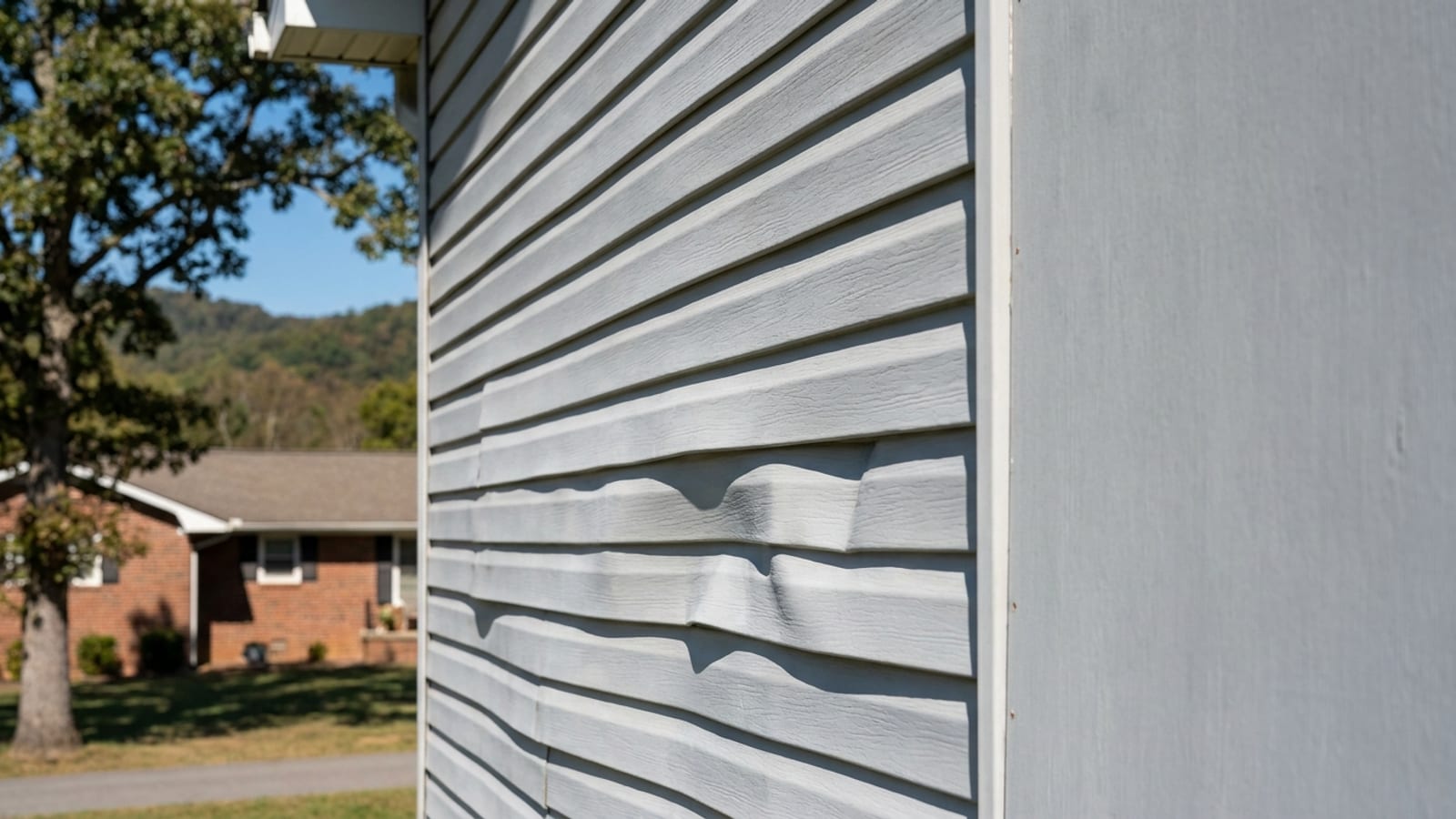
Paint failure and wood decay look similar from twenty feet and are not remotely the same problem. Peeling, chalking and gray, raised grain are surface conditions. A board can look terrible and still be structurally fine. Rot is a change in the wood itself, and it has a specific feel.
The screwdriver test
Pick a flat-blade screwdriver and press the tip firmly into the suspect area, especially along the bottom edge of the board, at butt joints, and where siding meets trim. Sound wood resists and leaves a shallow dent. Rotted wood takes the blade with almost no pressure, and the tip keeps going. If the screwdriver sinks a quarter inch or more, that board is done regardless of what the paint looks like.
Work the whole wall, not just the obvious spot. Test at ground level, under every window sill, at both ends of each elevation, behind downspouts, and at the bottom of any wall that sits below a roof valley. Then do the same on the shaded north and east walls, where the wall stays damp longest after rain.
Where rot starts on a wood-sided house
Decay needs moisture, and moisture collects in predictable places. On most homes in Tennessee, North Georgia and Northeast Alabama, the first soft boards show up at the bottom course near grade, at the ends of boards where two runs meet, under window sills where the flashing is tired, behind gutters that overflow every summer storm, and wherever a deck ledger, porch roof or rail post meets the wall. If your soft spots line up with those locations, you have a water path problem. If soft spots appear in the middle of clear wall with nothing above them, water is getting behind the cladding somewhere higher and traveling. That second pattern is the one that usually points toward full siding replacement rather than a patch.
What actually causes wood siding to rot here?
This climate is hard on wood. Long humid summers, heavy rain that arrives sideways, and shaded elevations that never fully dry out are the background conditions. On top of that, four specific failures cause most of the rot we see when old siding comes off:
- Gutters that overflow or leak. Water sheets down the wall instead of running to the ground, and it does it in the same place every time it rains.
- Failed flashing at windows, doors and roof-to-wall intersections. Sealant was used where flashing belonged, and sealant has a service life.
- Siding in contact with the ground or with mulch. Wood wicks moisture. Manufacturers specify a clearance above grade for exactly this reason.
- No drainage plane behind the boards. Older homes were often sided directly to sheathing or to felt that has long since torn. Any water that gets past the face has nowhere to go and nothing to dry it out.
Until the cause is fixed, new wood installed in the same spot rots on the same schedule. That is the part homeowners are rarely told before the second repair.
When is a repair the right call?
Repair is legitimate and often correct. You are a repair candidate when all of these are true:
- The damage is limited to a handful of boards on one elevation.
- The wood behind them, when a board comes off, is dry, hard and unstained.
- The source of water is identified and can be corrected — a gutter, a downspout, a flashing detail, mulch piled against the wall.
- The rest of the house holds paint reasonably well and passes the screwdriver test.
- You still have matching siding profile available, or a close enough match that the patch will not read as a patch from the street.
That is a carpentry job: cut out the bad boards, correct the water detail, install new material, prime all six sides including the cut ends, and paint. Done properly, it lasts. We do full-replacement siding only, so for a job like that a trusted local carpenter or painting contractor is the right person to call, and we will tell you so.
When does the whole wall need to come off?
Replacement becomes the cheaper answer faster than people expect. The tipping points:
| What you find | What it usually means | Repair or replace |
|---|---|---|
| Two or three soft boards in one spot, dry wood behind | Local water problem, contained | Repair, then fix the water path |
| Soft spots on three or more elevations | The whole cladding system has reached the end of its life | Replace |
| Sheathing stained, soft or crumbling behind the boards | Water got into the wall assembly | Replace, with sheathing repair |
| Paint will not hold more than three or four years anywhere | Moisture is moving through the wood constantly | Replace |
| Same area patched two or more times | The repair is treating a symptom | Replace |
| Interior signs on an exterior wall — stains, musty smell, soft trim | Water is inside the assembly, not just on it | Replace, and open the wall to see the extent |
| Fasteners will not hold in the wall | No sound substrate left | Replace |
There is also a plain arithmetic reason. Repairing a wood-sided house means matching a profile, priming and painting the patch, and then repainting the elevation so it does not look spotted. Do that three times over a decade and you have spent a meaningful share of what a full replacement costs, and you still own wood siding with the same water path behind it.
What does replacement cost, and what goes back on the wall?
A full siding replacement in our market typically runs $12,000 to $25,000 installed, including trim, soffit, fascia and house wrap. Where a specific house lands depends on square footage, number of stories, how much trim detail the elevations carry, and what the sheathing looks like once the old boards come off. Install time is usually four to seven days.
The material decision usually comes down to how long you plan to stay:
| Vinyl (Royal, Mastic) | Fiber cement (James Hardie) | Composite (Everlast) | |
|---|---|---|---|
| Relative installed cost | Lowest | Highest of the three | Between |
| Typical lifespan | 20–40 years | 30–50 years | Long, low maintenance |
| Rot potential | None | None | None |
| Repainting | Never | ColorPlus finish holds color | Not required |
| Best fit | Shorter ownership horizon, value priority | Staying ten-plus years, detailed elevations | Owners who want a painted look without paint upkeep |
All three solve the original problem, because none of them is wood. That is the quiet advantage of replacing rotted wood siding rather than replacing it with more wood: the failure mode you have been fighting goes away entirely. We are a James Hardie Alliance Select contractor, which means fiber cement gets installed to the fastening, clearance and flashing spec the warranty is written around.
What happens when the old siding comes off?
This is the part of the job that matters most and the part nobody can price from the driveway. Once the boards are down, the sheathing is visible for the first time in decades. Sound sheathing gets wrapped and sided. Damaged sheathing gets cut out and replaced before anything else goes on. Flashing at windows, doors and roof-to-wall intersections gets corrected, and a full house wrap goes on as a continuous drainage plane so that any water that gets past the face of the new siding has a path back out.
This is also why we do not side over existing siding. Covering rot seals the problem inside the wall where nobody looks at it again. The whole envelope comes off, gets inspected, gets corrected, and goes back on as one system covered by The Patriot's Promise — 30-year material and labor on siding, in writing.
If the number is the obstacle rather than the decision, financing through the GreenSky program includes no-interest-if-paid-in-full plans at 6, 15 or 18 months and fixed-rate terms for spreading it out on purpose, with zero down for most approved homeowners, subject to credit approval.
What should you do next?
Walk the house with a screwdriver this week. Test the bottom course, the butt joints, under the sills, and behind every downspout, on all four elevations. Count the soft spots and note where they cluster. If you find two or three in one place and dry wood behind them, fix the gutter or the flashing and have a carpenter cut in new boards.
If you find them on more than one wall, or the wood behind a board is stained, schedule a free in-home estimate. An estimator measures the elevations, looks at the trim, soffit and fascia, checks the areas you flagged, and gives you one itemized number with the scope spelled out. It is a sales appointment, and it is also the only way to get a real figure for your house instead of a guess off a square-footage calculator.