Short answer
Physically yes, one elevation can be re-sided on its own, and storm damage or a rot repair sometimes makes that the only sensible move in the moment. The problem is that the new wall almost never matches the old ones in color, profile or panel thickness, and the walls you left alone are the same age as the one that failed. Patriots' Pride does full-replacement siding only, because cladding performs and warranties as one system rather than four separate walls.
Physically, yes — one elevation can be re-sided on its own, and plenty of homes in Tennessee, Georgia and Alabama have had a single wall redone after a storm or a rot repair. Whether the house still reads as one house afterward is a different question, and the honest answer is usually no. Patriots' Pride does full-replacement siding only, and the reasons have less to do with selling you more work than with how a cladding system actually functions.
Siding is not four independent walls. It is one continuous water-management assembly made of house wrap, flashing, trim, corner posts, soffit and fascia, all lapped so water that gets behind a panel keeps moving down and out. When you cut into one elevation and leave the other three, you are splicing new work into an old system at the corners, and the corners are exactly where water intrusion starts.
Can one wall of siding be replaced on its own?
There are situations where a single wall genuinely is the whole problem. A tree limb through the north gable. A failed gutter that soaked one corner for three winters. A chimney chase that was flashed poorly from day one. In those cases the damage has a cause and a boundary, and the rest of the house may be fine.
The test is whether the rest of the cladding is still doing its job. Walk the house and press on the walls low, near grade and under window sills. If the other elevations are sound, square, holding color and not soft anywhere, you have a localized failure. If two or three walls show chalking that no longer cleans up, buckled panels, or soft spots, the single damaged wall is not an isolated event — it is the first one to go in a system that is finishing its service life.
That distinction decides everything that follows.
Why doesn't new siding ever match the old siding?
Three things work against a match, and they compound.
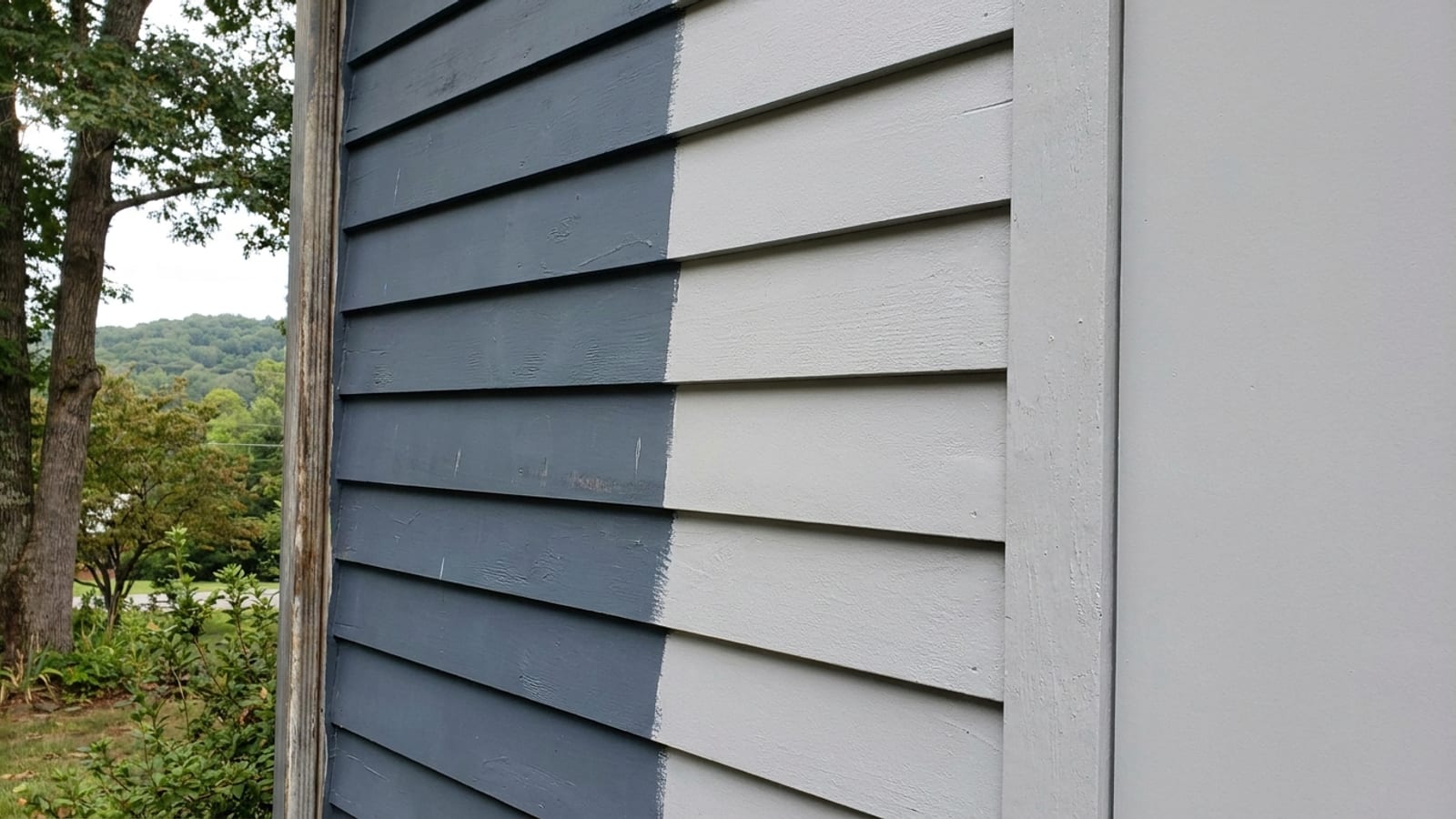
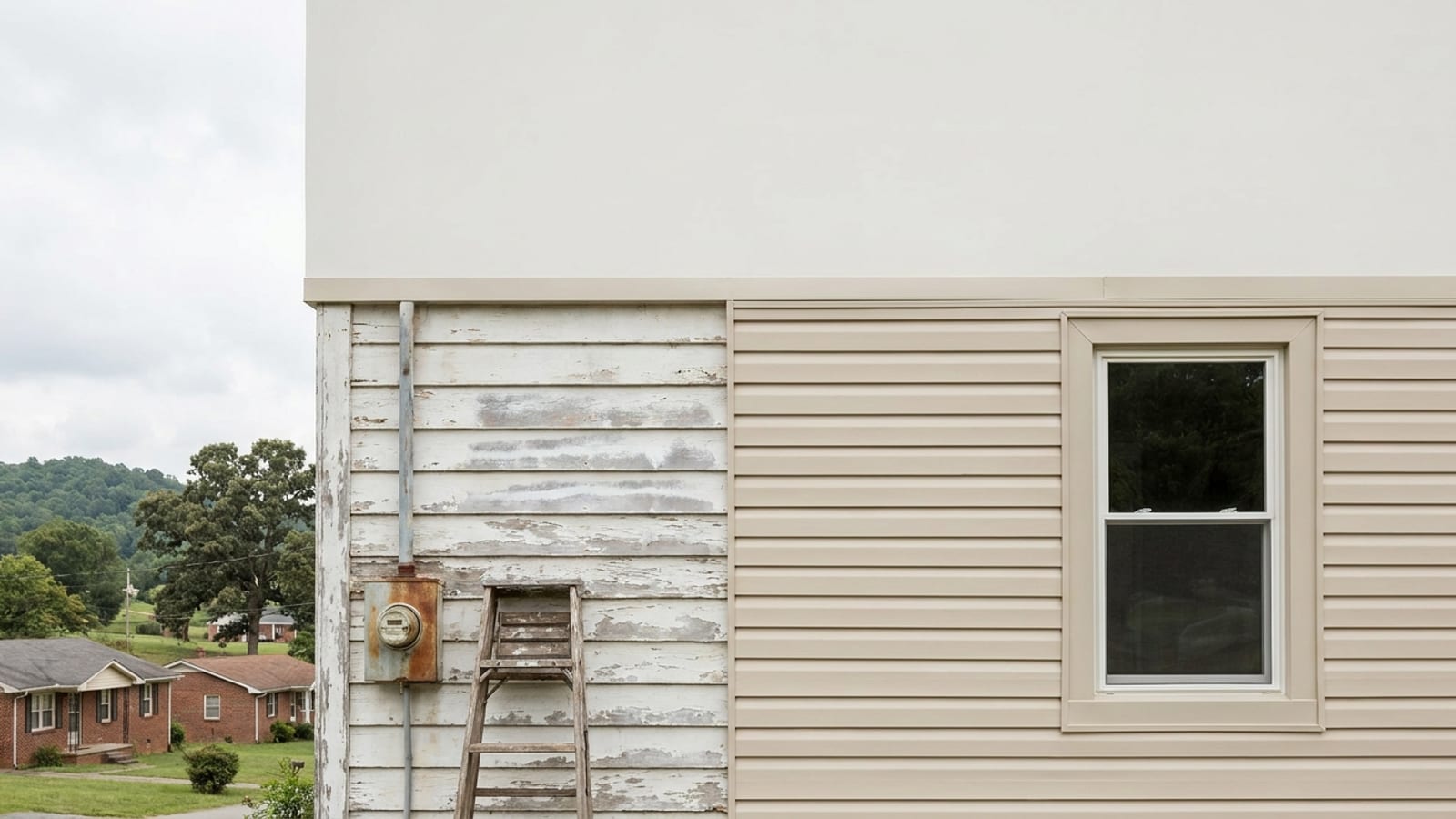
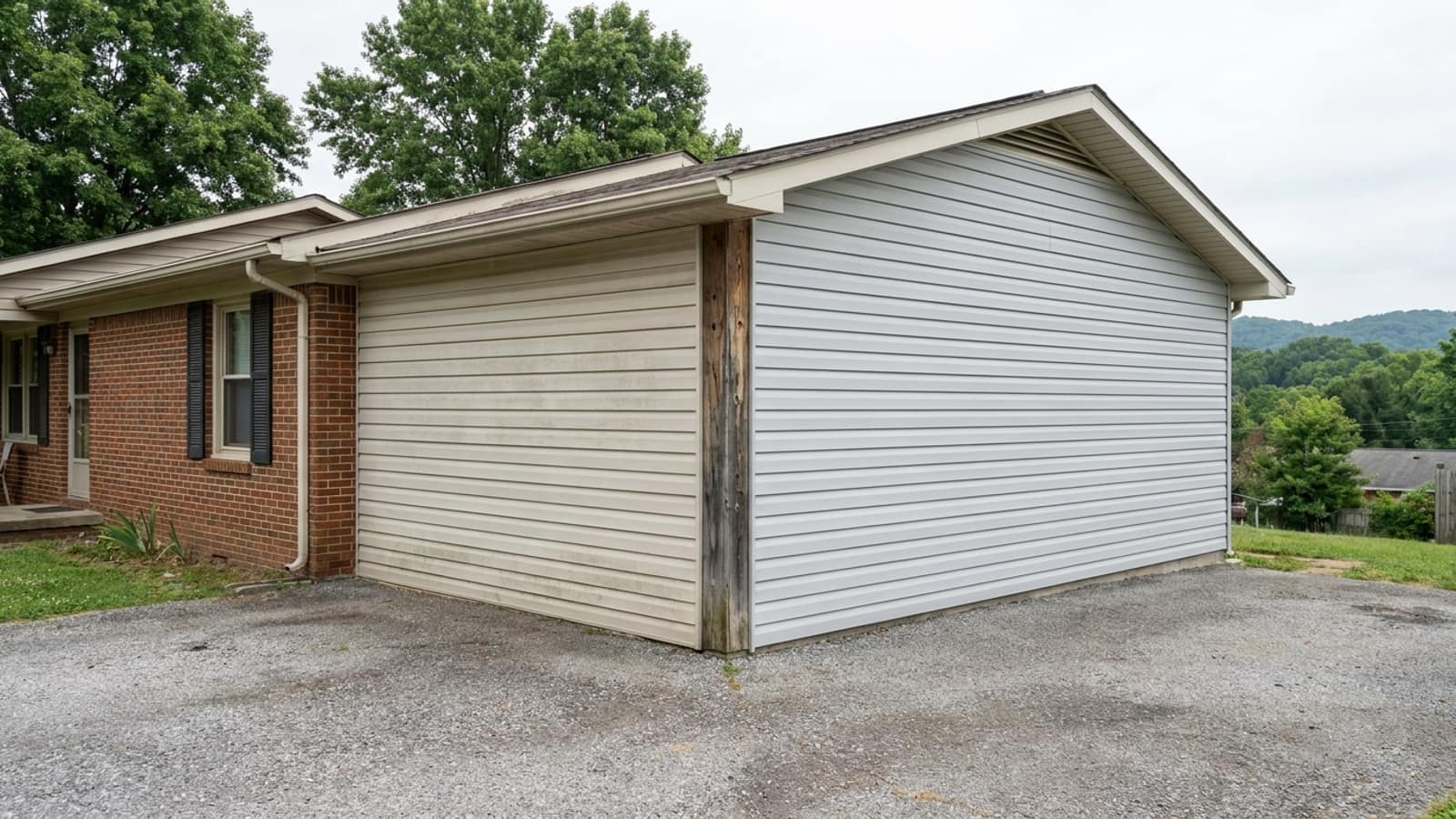
Color has moved. Vinyl chalks and fades, and that happens unevenly depending on how much sun each elevation takes. A west wall in the Tennessee Valley takes far more UV than a shaded north wall on the same house. Even if the manufacturer still makes your exact color — and after ten or fifteen years that is a real if — the new panels come out of the box at the original shade while the neighboring wall has drifted. The brightest new siding on the house draws the eye straight to it.
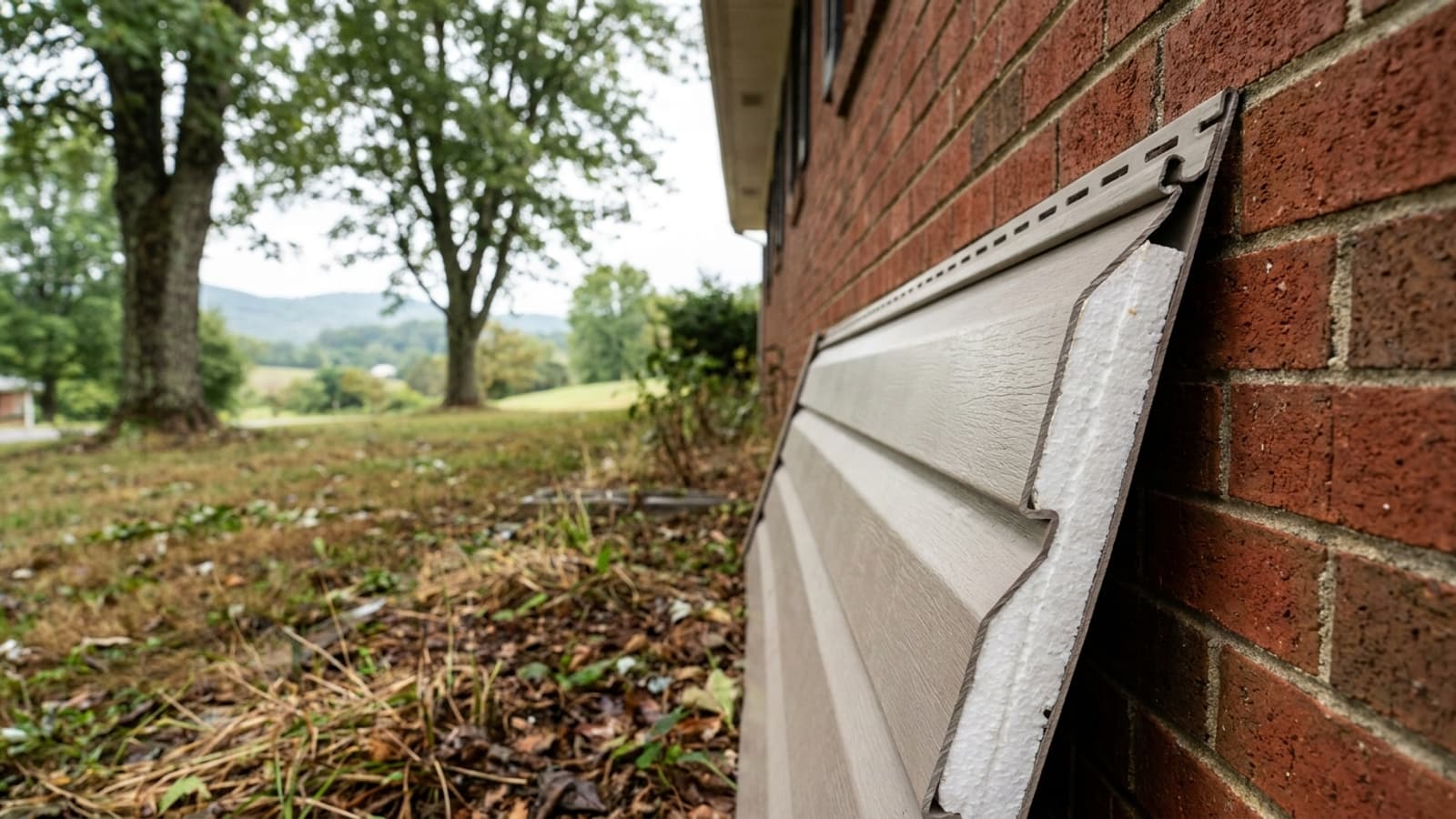
Profiles change. Panel exposure, lock design, nailing hem geometry and thickness all get revised over the years. A current double-4 does not always line up with a discontinued double-4, which means the shadow lines across a corner post do not stack at the same heights. People notice that even when they cannot name what they are seeing.
Product lines retire. Discontinued colors and discontinued profiles are the normal outcome, not the exception. The further back your siding was installed, the lower the odds of a clean match.
Fiber cement behaves a little better here because plank exposures are more standardized and the finish holds color much longer, but a factory-finished new plank next to a fifteen-year-old painted one still shows.
What does a partial siding job cost compared to a full replacement?
Partial work does not scale down the way homeowners expect. The fixed costs — mobilization, staging, permits where required, disposal, a crew showing up — land on a one-wall job almost the same as on a whole-house job. Spread across a quarter of the square footage, the per-square cost goes up, sometimes sharply. Then you pay the same fixed costs again when the next wall fails.
Here is how the decision usually sorts out.
| Situation | Rest of the house | Practical answer |
|---|---|---|
| Storm or impact damage on one wall | Sound, holding color, no soft spots | Localized repair or an insurance-funded wall |
| Rot at one corner from a gutter failure | Sound elsewhere | Fix the water source first, then assess scope |
| One faded wall, three walls chalking | Same age, same decline | Full replacement |
| Repeated patching in the same areas | Multiple elevations involved | Full replacement |
| Moisture or mold showing inside an exterior wall | Any condition | Open the wall and find out before deciding |
A full siding replacement in our market typically runs $12,000 to $25,000 installed, and that number includes trim, soffit, fascia and house wrap rather than panels alone. Where a particular house lands depends on square footage, how many stories, how much trim detail the elevations carry, and what the sheathing looks like once the old siding comes off. If the number is the obstacle rather than the logic, financing through the GreenSky program is how most homeowners spread it — including no-interest plans at 6, 15 or 18 months and fixed-rate terms for people who would rather pay it out over years on purpose.
What happens behind the siding when only one wall comes off?
This is the part that matters more than appearance. The only time anyone gets to look at your sheathing, your house wrap, your window flashing and your framing is when the cladding is off. On a full replacement, every square foot of that assembly gets inspected and corrected before new material goes on.
Take one wall off and you have inspected one wall. The window on the adjacent elevation that has been leaking slowly into the stud cavity stays hidden. The house wrap that was never lapped correctly over the band joist stays hidden. New siding on the north wall tells you nothing about the south wall, and it buys you no information about the part of the house you cannot see.
There is also the transition itself. Where new work meets old, you need a corner post, a vertical trim detail or a J-channel run that sheds water in both directions and ties into whatever wrap exists on the untouched side. That joint is doable, but it is a seam in a system that was designed not to have one, and seams are where the next problem begins.
How do you get the look right if the budget only covers part of it?
There is a better version of partial work, and it is about material rather than elevation.
Doing the whole envelope at once while mixing materials is a legitimate way to put money where it shows. James Hardie fiber cement on the street-facing elevations and quality vinyl on the sides and rear is a common, honest compromise. The house wrap, flashing, trim and corner details all stay continuous because it is one project, every wall gets inspected, and the whole system is warrantied together. What you are varying is product, not coverage.
The other legitimate approach is sequencing by project rather than by wall. If the siding still has life in it and your windows are the real complaint, do the windows now and the siding later. Coordinating trades on the exterior is a scheduling question we work through all the time, and doing both together has its own advantages when the timing lines up.
What does the warranty look like either way?
Ask for the labor term specifically, not just the material term. Our siding carries 30-year material and labor coverage under the Patriot's Promise, backed by a signed timeline agreement and $2 million in liability insurance on every job. A lifetime material warranty paired with a one-year labor warranty is a far weaker promise than it sounds, and on exterior cladding most of what ever needs attention involves installation details rather than the panel itself.
Whole-envelope installation is what makes that coverage meaningful. Trim, soffit, fascia and house wrap go on as one system, fastened to manufacturer spec by a James Hardie Alliance Select contractor, which is the standard the warranty is written against.
What is the next step?
If one wall looks bad and you are not sure whether the rest of the house is close behind, have someone measure and inspect all four elevations before you commit to a scope. That walk is what tells you whether you are looking at a damaged wall or a cladding system at the end of its run — and it is the only way to get a real number instead of a guess.
Schedule a free in-home estimate at /get-estimate/. An estimator measures the house, checks the condition of the walls, trim, soffit and fascia, shows you the material options side by side, and gives you one itemized price. It is a sales appointment, and it is also the most useful hour you will spend on this decision.