Short answer
Usually yes when the damage comes from a sudden covered event — wind, hail, a falling limb, a vehicle or fire — and usually no when it comes from age, fading, chalking, mildew or deferred maintenance. A standard homeowners policy pays to repair or replace damaged cladding minus your deductible, and whether you get repair money or full-wall money often comes down to your insurer's rules on matching undamaged panels. Read the perils and the deductible on your own declarations page, because coverage varies by policy.
Most homeowners policies cover siding damage when it is caused by a sudden, covered event — a windstorm, hail, a falling tree limb, a vehicle, a fire. Most policies do not cover siding that simply wore out: faded and chalked panels, brittle vinyl that cracked from age, mildew on a shaded wall, or rot that has been spreading behind the cladding for years. That single distinction — sudden event versus gradual deterioration — decides the majority of siding claims before anyone talks about dollars.
What follows is how the coverage actually works, what a deductible does to the math, why "matching" is the fight that decides so many of these claims, and how a claim payment fits with a full siding replacement when the wall needs more than a patch.
What kinds of siding damage does a policy usually cover?
A standard homeowners policy insures the structure against a list of named perils or against everything except a list of exclusions, depending on the form you bought. In both cases, the covered causes that come up on siding claims in Tennessee, Georgia and Alabama look like this.
Wind
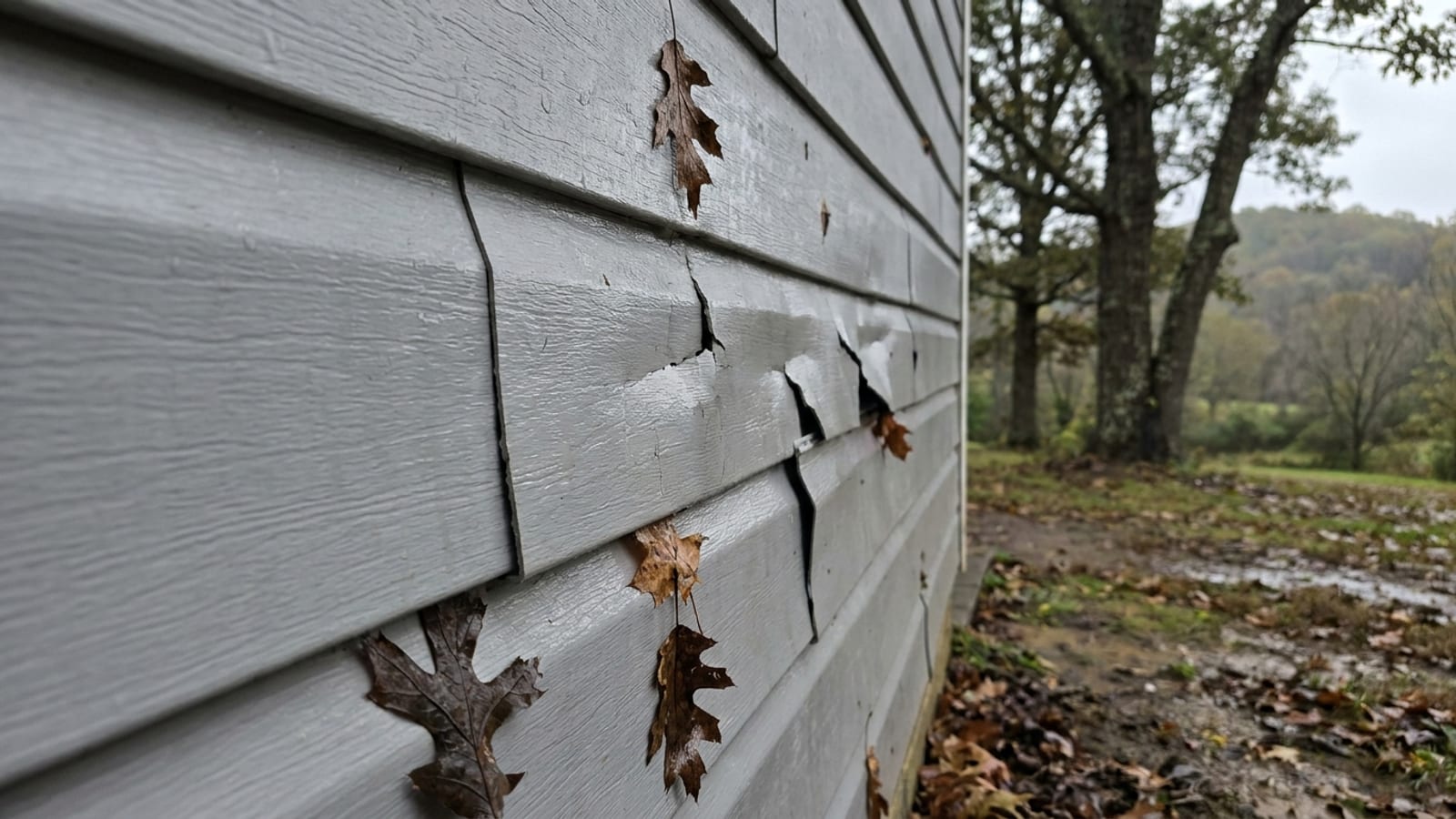
Straight-line winds and the wind field around a thunderstorm pull panels loose at the nail hem, unzip a run of vinyl at a butt joint, or tear off a whole course. Wind damage is the single most common siding claim in this region. It is also the one where damage is easy to miss from the ground — a panel can be unlatched and still look flat from the driveway.
Hail
Hail dents and cracks vinyl, chips fiber cement and knocks the finish off aluminum. Adjusters look for a random impact pattern with matching hits on soft metals nearby — gutters, downspouts, window wraps, the roof vents. If those show hail and the siding does not, the claim gets harder.
Impact from trees, limbs and vehicles
A limb through the wall is the cleanest kind of claim there is: obvious cause, obvious date, obvious damage. The same is true of a vehicle backing into a corner board.
Fire and smoke
Heat from a fire — including a grill or a fire pit too close to a wall — melts or deforms vinyl. That is generally a covered loss, though the underlying safe-distance issue is worth fixing before the new siding goes up.
What does insurance almost never cover?
The exclusions are about time and maintenance rather than weather.
| Situation | Typically covered? | Why |
|---|---|---|
| Wind tore panels off during a storm | Yes | Sudden covered peril |
| Hail cracked or dented panels | Yes | Sudden covered peril |
| Tree limb punched through the wall | Yes | Sudden covered peril |
| Vehicle hit the corner of the house | Yes | Sudden covered peril |
| Color faded and chalked over 20 years | No | Normal wear and aging |
| Mildew and algae on the shaded walls | No | Maintenance item |
| Rot behind the siding from a leaking gutter | No | Gradual water damage, often excluded |
| Panels cracked from age and brittleness | No | Wear, not a peril |
| Rising water from a flood | No | Requires separate flood coverage |
| Pest or woodpecker damage | Usually no | Common exclusion, varies by policy |
| Earth movement or settling | No | Standard exclusion |
One more that catches people: damage that could have been prevented by maintenance. If a gutter has been overflowing onto the same wall for six years and the sheathing behind the siding is soft, that is not a storm claim. It is a repair, and it is the kind of thing we find under old cladding regularly.
How do deductibles and ACV versus RCV change the check?
Two numbers on your declarations page do most of the work.
Your deductible. A flat deductible is a dollar figure — $1,000, $2,500. A percentage deductible, common on wind and hail in storm-prone areas, is a percentage of the dwelling coverage amount. On a home insured for $400,000, a 2% wind and hail deductible is $8,000 out of pocket before the policy pays anything. Homeowners who have never read that line are often surprised by it at the worst possible moment. Find it now, not after the storm.
Actual cash value versus replacement cost value. ACV pays what the damaged siding was worth in its depreciated, 18-year-old condition. RCV pays what it costs to replace it today, usually in two checks: an initial ACV payment, then the recoverable depreciation released once the work is finished and documented. If your policy is written on ACV, the check on a 20-year-old wall will be a fraction of what the wall costs to redo. That is not the adjuster being difficult. That is the coverage you purchased.
What is matching, and why does it decide so many siding claims?
Here is where siding claims differ from roof claims. Suppose hail damaged 40 square feet on the west elevation. Your insurer's first position may be to pay for 40 square feet of replacement panel. But siding colors change, product lines get discontinued, and vinyl fades over two decades, so a new panel dropped into a 20-year-old wall reads as a patch from the street.
Some states and some policies address this with matching language — an obligation to produce a reasonably uniform appearance, often applied to a full elevation or a full line of sight rather than to the individual damaged panels. Other policies are silent on it and pay for the damaged area only. Ask the adjuster directly, in writing, how matching is handled on your policy and whether the scope is per panel, per elevation or per line of sight. That answer changes the number more than anything else in the claim.
What should you do in the first week after storm damage?
- Photograph everything before anything is touched, wide and close, with the date intact. Include the gutters, downspouts and window wraps — soft metals corroborate hail.
- Make reasonable temporary repairs to stop further water entry and keep the receipts. Policies generally require you to prevent additional damage.
- Call your carrier and open the claim. Write down the claim number and the adjuster's name.
- Get an independent itemized estimate for the repair or replacement so you have a real scope to compare against the adjuster's.
- Read anything before you sign it, particularly an assignment of benefits. You are never required to sign one to get an estimate.
Does a partial claim payment work with a full siding replacement?
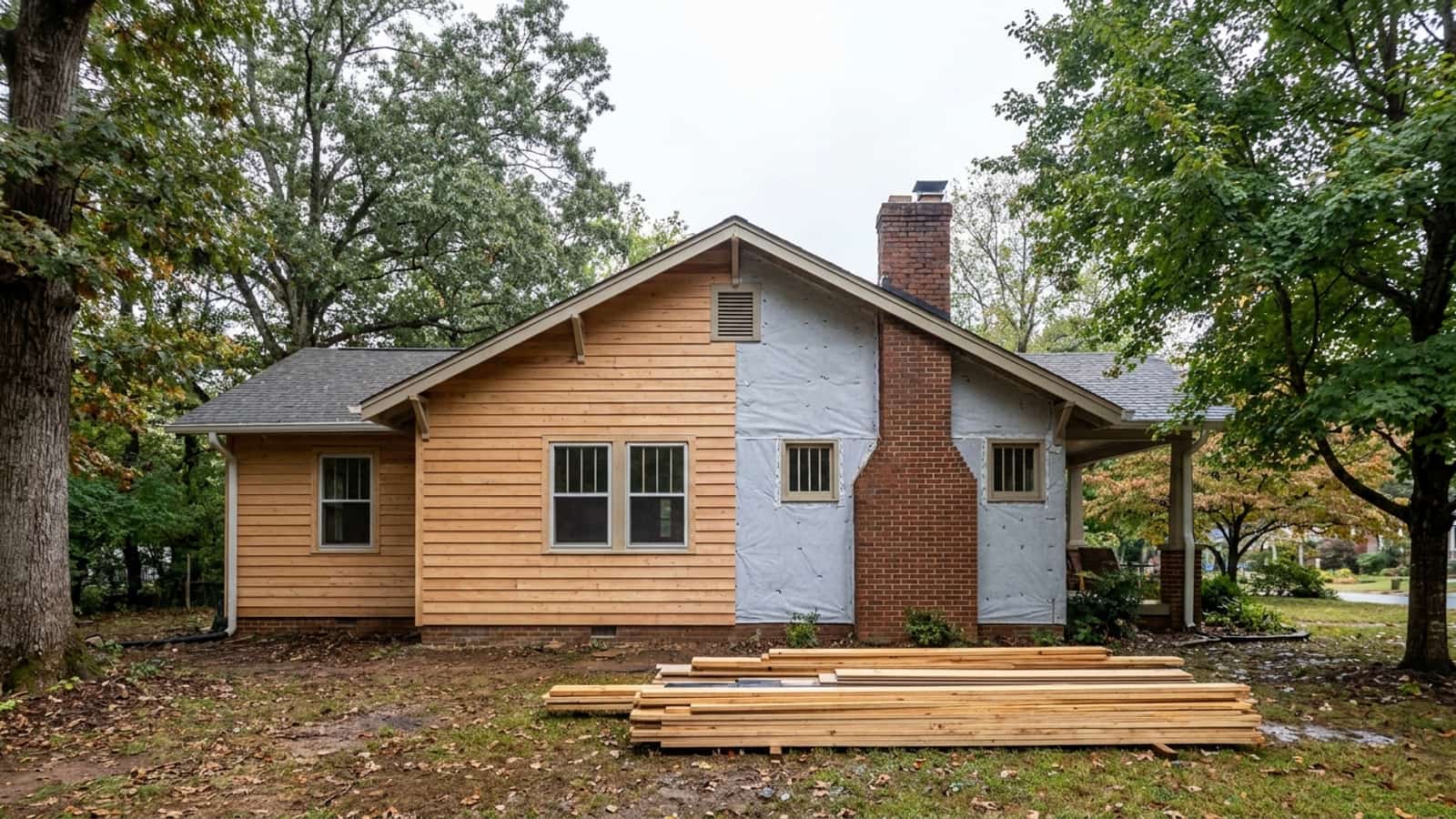
Sometimes yes, and it is worth being clear about how we operate. Patriots' Pride does full siding replacement only — we do not patch a failing system or side over rot. That means if your claim pays for one damaged elevation and the other three walls are sound, the insurance scope and our scope will not match, and you should know that before the adjuster leaves.
Where it does line up well is when the storm is the event that finally makes the case for redoing the envelope. Many homeowners are already looking at fading, chalking and repeated patching when the wind takes a wall. In that situation the claim covers what the storm caused, and the homeowner covers the upgrade from a 20-year-old wall to a new system — house wrap, trim, soffit, fascia, all of it as one assembly. A full replacement in this market typically runs $12,000 to $25,000 installed depending on square footage, stories, trim detail and what the sheathing looks like once the old siding comes off. If the gap between the claim check and the project number needs to be spread out, financing through the GreenSky program is the usual route, with no-interest-if-paid-in-full plans and fixed-rate terms.
What happens to the warranty on siding paid for by a claim?
Nothing changes. The source of the money has no effect on the coverage on the work. New siding installed by Patriots' Pride carries a 30-year material and labor warranty under The Patriot's Promise, and as a James Hardie Alliance Select contractor we install fiber cement to manufacturer spec so the product warranty stands behind the job too.
One warranty note worth raising with your adjuster: manufacturer warranties on siding generally do not cover storm damage or impact. That is the insurance policy's job, not the manufacturer's. A hail-dented panel is not a defective panel.
How do you keep the next storm from turning into the same conversation?
A few things genuinely reduce the odds of a repeat claim. Keep gutters clear so water leaves the roof edge instead of running down the wall. Trim limbs back off the house. Check butt joints and J-channel after every significant wind event, because a panel that came unlatched and got pushed back into place is no longer sealed. And understand the material difference: vinyl is the value answer and will dent and crack under hail, while fiber cement takes impact and heat far better and is the reason many homeowners in storm-exposed spots move to it when the wall comes off anyway.
What to do next
If a storm hit your walls, open the claim with your carrier first, then get an independent number so you know what the work actually costs. Schedule a free in-home estimate at /get-estimate/ and you will get one itemized price covering siding, trim, soffit, fascia and house wrap — a document you can put in front of your adjuster and a scope you can hold us to.