Short answer
Usually yes, because the screen is the least expensive replaceable part of a window and a torn one costs you the ventilation you paid for. Rescreening an existing frame is the low-cost route when the frame is straight and the spline channel is intact, while a new frame or a factory screen ordered from the window manufacturer is the answer once the frame is bent, the corners have pulled apart, or the unit is a modern half-screen that has to match the sash. A bad screen by itself is not a reason to replace a window, but a window that no longer holds its screen square often has other problems worth a closer look.
Most of the time, yes. A screen is the least expensive replaceable part of a window, and a torn or sagging one takes away the exact thing an operable window is for — opening it. The question is rarely whether to fix the screen. It is whether to rescreen the frame you have, order a new frame, or accept that the screen is telling you something about the window behind it.
Here is how to tell those three apart, what each one involves, and which mesh is worth choosing when you do have the option.
What actually fails on a window screen?
A screen is four parts, and they fail in a predictable order.
The mesh
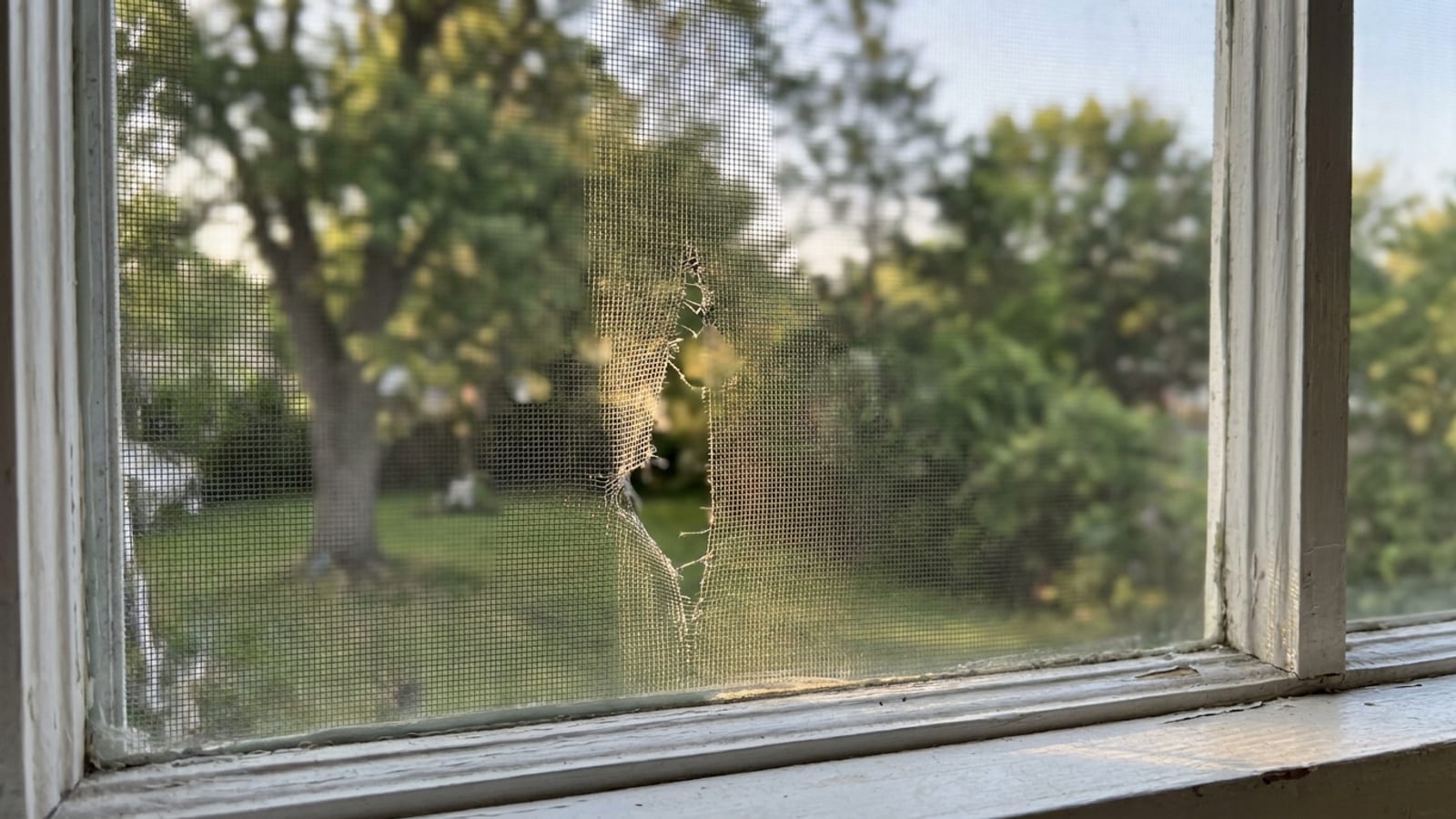
This goes first, almost every time. Standard fiberglass mesh is a coated woven fabric, and years of direct Southeast sun make the coating chalky and the strands brittle. Eventually a branch, a dog, a ladder or a curious kid puts a hole in it. Aluminum mesh dents and creases instead of tearing, which is its own kind of ugly but usually still functional.
The spline
The spline is the flexible cord pressed into a groove around the frame that holds the mesh in place. It dries out and shrinks over time. When it does, the mesh pulls loose at a corner and the whole panel starts to ripple. A screen that has come loose on one edge but is not torn is almost always a spline problem, and it is the cheapest fix there is.
The frame
Most screen frames are thin roll-formed aluminum. They bend when a panel gets leaned against something, dropped, or forced back into an opening at an angle. A bent frame will not sit flat against the window, which leaves a gap along one edge — and a gap in a screen defeats the entire point of the screen.
The corner keys and hardware
The plastic corner keys that join the four frame pieces get brittle with UV exposure and snap. Once two corners are loose, the frame goes out of square and no amount of new mesh will make it sit right. The pull tabs, clips and spring-loaded plungers that hold the screen in the track fail the same way.
If you are already at the point of replacing several screens and the windows themselves are original single-pane or early vinyl units, it is worth reading our window replacement page before spending money on screens for windows you plan to change out within a couple of years.
Should you rescreen the frame or buy a new one?
The test is the frame, not the mesh. Lay the screen on a flat surface. If all four corners touch, the frame is square, and the spline channel is clean and undamaged, rescreening is the right answer and it is the cheapest thing you will do to your house all year. If the frame rocks, a corner is loose, or the channel is crushed, build or order a new frame — new mesh in a bad frame is wasted work.
| Option | When it fits | Relative cost | Who usually does it |
|---|---|---|---|
| New spline only | Mesh is intact, one edge pulled loose | Lowest | Homeowner, 10 minutes |
| Rescreen existing frame | Frame straight and square, mesh torn or brittle | Low | Homeowner or a local screen shop |
| New frame, shop-built | Frame bent, corners broken, odd size | Moderate | Screen shop from your measurements |
| Factory screen from the manufacturer | Modern window where the screen has to match the sash and track exactly | Moderate to higher | Ordered through the installing company |
| Replace the window | Screen problems plus fogged glass, rot or a sash that will not stay up | Window pricing applies | Installing contractor |
That last row matters. Replacement windows in our market run $700 to $2,200 per window installed, so a screen decision and a window decision are not remotely the same size of problem. Do not let a screen quote turn into a window project unless the window itself has earned it.
Which screen mesh should you choose?
Once you are rescreening anyway, the mesh is a real choice and most people default to whatever was there before.
| Mesh type | What it does well | Tradeoff |
|---|---|---|
| Standard fiberglass | Inexpensive, easy to work with, good visibility | Least durable in direct sun and around pets |
| Aluminum | Holds shape, lasts longer, will not sag | Dents and creases permanently; can corrode near heavy road salt |
| Pet-resistant | Heavy vinyl-coated polyester that resists claws | Noticeably thicker weave, so less light and airflow |
| Solar / sun-blocking | Cuts glare and solar heat before it reaches the glass | Darker, hazier view; best used only on sun-hammered elevations |
| No-see-um / fine mesh | Stops the smallest insects | Finer weave reduces airflow and clogs with pollen faster |
In Tennessee, Georgia and Alabama, the one upgrade worth thinking hard about is solar mesh on west- and south-facing windows. Our climate is cooling-dominated — the number that drives summer comfort here is solar heat gain, not furnace heat loss. Blocking part of that sun outside the glass helps on the elevations that take a beating from two o'clock on. On north-facing windows it just makes the room dimmer for no benefit.
Do screens hurt your view and airflow?
Yes, and it is worth being honest about how much. Any screen reduces the light coming through the glass and softens the view — that is unavoidable with a woven fabric stretched across the opening. Finer and heavier weaves reduce it more.
That is why half screens exist. On a double-hung, a half screen covers only the lower sash, leaving the upper sash clear glass. You still get ventilation through the bottom, and you keep a clean view through the top half of the window. Some homeowners go the other direction and order full screens on every opening because they want both sashes open in spring and fall. Both are legitimate; it is a preference, and it is one of the small decisions that gets made at the estimate and then lives with you for twenty years.
One thing worth knowing about casement and awning windows: the screen sits on the interior side because the sash swings outward. If you are used to double-hungs, that is a change, and it means the screen is the surface you touch and clean from inside the room.
When is a bad screen actually a window problem?
A screen tells on the window. Look for these:
- The screen will not stay in the track. If the plungers engage but the panel still falls out, the window frame may have racked out of square.
- There is a visible gap along one edge with a straight screen frame. That is the window, not the screen.
- The screen track is corroded or pitted. Common on original aluminum-frame windows, and the screens never seat properly again once it gets bad.
- You are replacing screens on windows that are also fogged between the panes. Fog between the panes means a failed insulated glass seal, and that is a window conversation.
- The sash will not stay open to hold the screen useful. A window you have to prop open is not giving you the ventilation the screen is for.
One or two of these on one window is a repair. Several of them across the house usually means the screens are the visible symptom of units that are simply at the end of their service life. Most windows last 20 to 30 years, and original single-pane and early vinyl units are the first to go.
Are replacement screens covered under a window warranty?
It depends on the warranty, and this is one of the places where warranties differ the most. Screens are frequently treated as a separate category from the window itself, with a shorter term or an exclusion for accidental damage — a hole your dog put in the mesh is not a manufacturing defect in anyone's book. What a good warranty should state clearly is the term for material and the term for labor, in writing, so you know before you call.
Our window warranty is covered under The Patriot's Promise — lifetime material and labor on windows, transferable once and then prorated. If your windows came from us and a screen has an issue, reach out through the contact page and we will tell you straight whether it falls under warranty or is a parts order.
What is the next step?
If it is one torn screen on a sound window, get a spline tool and a roll of mesh, or take the frame to a local screen shop and be done with it for very little money. That is the honest answer and it does not require us.
If you are looking at a house full of tired screens on windows that also stick, fog, or leak air you can feel with them shut, the screens are not the project. Book a free in-home estimate at get an estimate. An estimator measures every opening, checks the condition of the frames and sills, shows you glass and screen options, and gives you one itemized price per opening with the install method spelled out. It is a sales appointment, and it is also the only way to get a real number instead of a guess.