Short answer
Most of a sliding patio door's security comes from three things working together: a latch that actually engages its keeper, a frame that cannot be pried or lifted, and glass that stays in the opening when it breaks. Inexpensive additions like a secondary pin lock, a track bar and anti-lift screws stop the easy attacks and take minutes to install. When the frame has racked, the keeper no longer lines up or the panel can be lifted out of the track, no add-on lock fixes that and the door itself needs replacing.
A sliding patio door is secured by three things, not one: the latch that holds the panel closed, the frame and track that keep the panel where it belongs, and the glass itself. Most homeowners only think about the first one. The cheapest and fastest improvements usually come from the second, and the most durable improvement comes from the third.
Here is what actually works on a patio door, in the order most people should do it, and the point at which hardware stops being the answer.
Why is a sliding patio door the weak point on most houses?
An entry door is a slab held in a frame by hinges on one side and a deadbolt throwing an inch of steel into a strike plate on the other. A sliding door is a large panel of glass that hangs on rollers in a track, held shut by a latch hook that catches a keeper in the jamb. It also sits at the back of the house, usually facing a fenced yard, usually out of view of the street. That combination of a lighter mechanism and better cover is why the back patio door gets attention.
The common failure points are predictable:
- The latch is a single point near the handle height, so the top and bottom of the panel are held by nothing.
- The panel can often be lifted up in its track far enough to clear the sill and come out.
- Old aluminum frames flex, which lets the latch hook slip past its keeper under pressure.
- The glass in older units is often plain tempered glass, which breaks into small pieces and leaves a clean opening.
None of that means a sliding door is a bad choice. A current patio door installed square, with a modern lock and the right glass, is a solid part of the envelope. It means the door you already have deserves an honest look before you decide whether a lock is the fix.
What locks actually come on a sliding patio door?
The factory latch
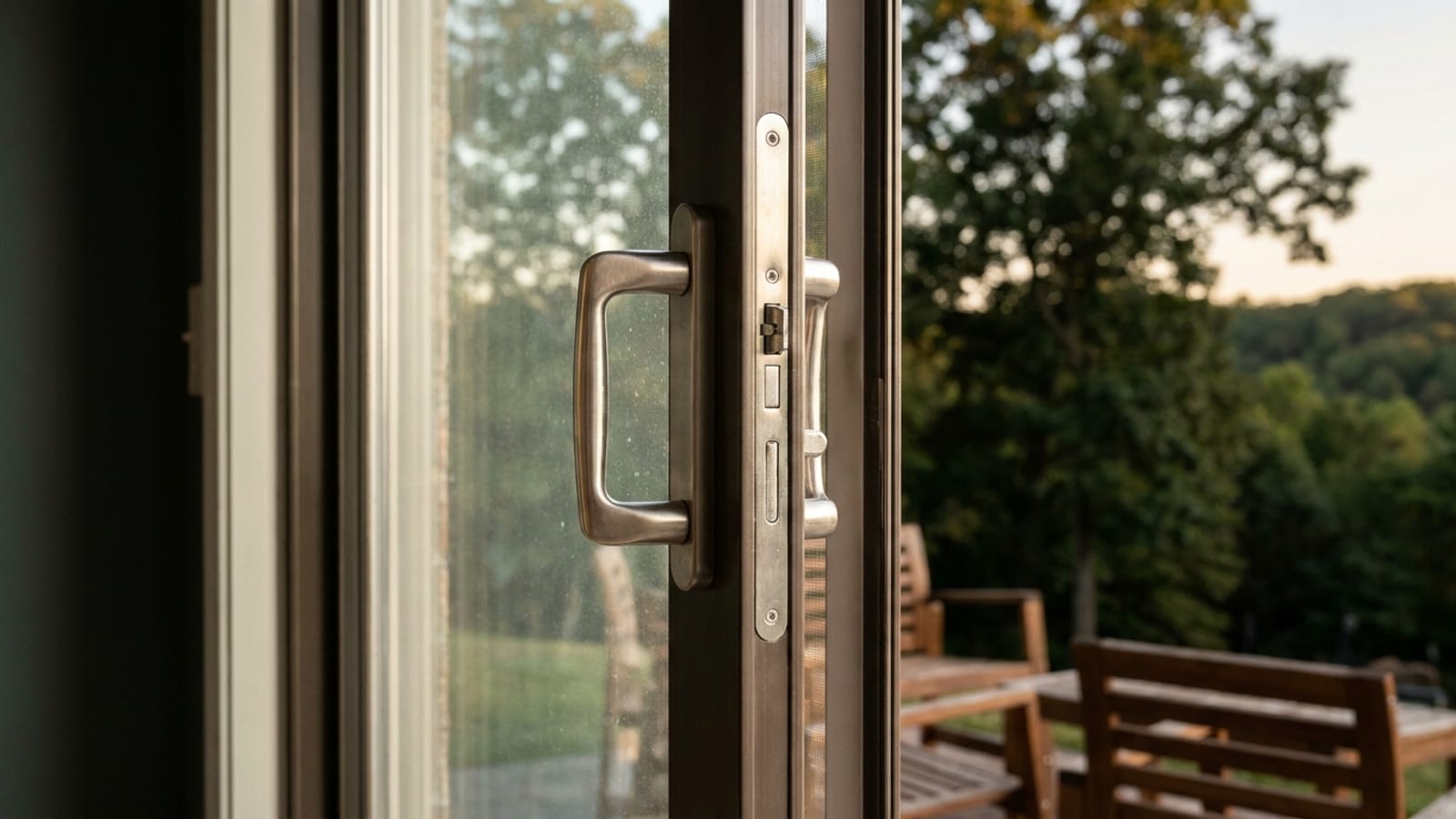
Most sliding doors use a hook latch operated by the handle. When the door is square and the keeper is adjusted, that hook does its job. When the panel has settled, the hook can sit low or high against the keeper and only catch partway. You can test this in ten seconds: lock the door, then push and pull the handle hard. If the panel moves more than a hair, the latch is not fully engaged and the door is giving you a false sense of being locked.
Multipoint locks
Newer sliding and French patio doors are often available with a multipoint lock, which throws hooks or bolts at two or three heights up the panel instead of one point at the handle. This is the single biggest hardware upgrade available, and it does double duty: it holds the panel against the weatherstripping along its whole height, so the door seals better as well as locks better. Multipoint hardware generally comes with the door rather than being retrofitted into an old one.
Auxiliary pin locks and foot bolts
A pin lock drills through the moving panel's stile and into the fixed panel or the frame, pinning the two together independently of the handle latch. A foot bolt does the same thing at the bottom of the panel. Both are inexpensive, both are mechanical, and both work even if the primary latch is worn. On many doors you can also drill a second pin hole a few inches up so the door can be pinned partly open for ventilation.
Track bars
The bar in the track, sometimes called a charley bar or a security bar, blocks the panel from sliding. It is the oldest trick on the list and it still works. Sized correctly, with no slop at either end, it means the panel cannot travel even if the latch fails entirely.
Anti-lift screws
The simplest fix on this page. Drive a few pan head screws into the upper track so their heads hang down just above the top of the panel, close enough that the panel cannot be lifted clear of the sill but not so close that it binds while rolling. This removes the lift-and-pull attack that defeats every latch and bar on the list.
Which patio door upgrades are worth the money?
| Upgrade | What it stops | Effort | Main limitation |
|---|---|---|---|
| Anti-lift screws | Panel being lifted out of the track | Minutes, very low cost | Does nothing about sliding or glass |
| Track bar | Panel sliding open | Minutes, low cost | Has to be removed to use the door |
| Auxiliary pin lock | Sliding, and a worn primary latch | An hour, low cost | Needs a solid stile to drill into |
| Keeper adjustment | A latch that only partly engages | Minutes, no cost | Only helps if the frame is still square |
| Laminated glass | Breaking the glass to make an opening | Comes with a new door | Not a retrofit on most old units |
| Multipoint lock | Prying and single-point latch failure | Comes with a new door | Not a retrofit on most old units |
| Replacing the door | All of the above at once | 1 to 2 days install | Highest cost of the list |
The honest order of operations is top to bottom. Spend the small money first, because on a sound door it closes most of the gap. If the door is not sound, the small money is wasted and you will know that within an hour of trying.
Does the glass matter more than the lock?
On a door that is already latching properly, yes. A lock is irrelevant to someone willing to break glass, and a patio door is mostly glass.
Safety glazing is required by code in and around doors, so patio door glass is already either tempered or laminated. The difference between them matters here. Tempered glass is strong until it is not, and when it fails it breaks into small granular pieces and clears the opening completely. Laminated glass is two lites bonded to a plastic interlayer. Strike it and it cracks, but the interlayer holds the pieces in place, so the opening does not open. It takes sustained, loud, obvious effort to get through it.
Laminated glass also happens to be one of the better noise reducers available in a glass package and it blocks the large majority of UV that fades floors and furniture. For a patio door on a ground-floor rear elevation, it is the upgrade that earns its cost in more than one way.
What about security film on existing glass?
Aftermarket film applied to the room side of existing glass offers some resistance and holds fragments together to a degree. It is not equivalent to factory laminated glass, because the film is only bonded to the surface and the glass is still only held in the frame by the glazing bead. It is a reasonable interim step on a door you are not ready to replace. Just be clear with yourself about what it is.
When is the door itself the problem?
Hardware stops being the answer at a specific point. Replace the door rather than adding locks when any of these are true:
- The frame has racked, so the panel no longer meets the jamb evenly top to bottom and the latch will not line up no matter how the keeper is adjusted.
- The track is bent, worn through or the rollers have already been replaced once and the panel is dragging again.
- The panel can be lifted far enough to come out of the track even with the screws in place.
- The glass is fogged between the panes, meaning the insulated glass seal has failed.
- The door is an older aluminum unit that flexes visibly when you push on the stile.
A door you have to shoulder or lift to operate is not a hardware problem. The whole unit has moved, and new hardware mounted to a frame that is out of square ends up as badly aligned as the hardware you took off.
A replacement patio door in our market falls inside the installed door range of $3,973 to $7,500, which covers the unit, the frame, the hardware, the labor and the finish work. Where a specific door lands depends on width, panel count, glass package and what the crew finds under the threshold once the old unit comes out. If spreading that number is part of the decision, we offer financing through the GreenSky program, including no-interest-if-paid-in-full plans and fixed-rate terms, with zero down for most approved homeowners and credit approval required.
Do French patio doors lock better than sliding doors?
They can, and it depends entirely on the hardware. A French patio door with a multipoint lock throws bolts into the head and sill as well as the jamb, which is a strong configuration. A French door with a single deadbolt and a loose inactive panel is not better than a well-latched slider, because the inactive panel is often the weak side. Ask specifically about the lock type and how the inactive panel is secured at the top and bottom, not about the door style.
Do cameras, sensors and smart locks help?
They help with awareness, not with resistance. A contact sensor on the panel tells you the door opened. A camera gives you a record. Neither one slows anyone down at the door itself. Treat electronics as a layer on top of mechanical security rather than a substitute for it, and put the money into the pin lock, the anti-lift screws and the glass first.
How does installation affect patio door security?
More than the hardware catalog does. A patio door that is set plumb, square and level, shimmed at the jambs and under the sill, fastened to structure rather than to trim and sealed at the perimeter is a door whose latch will still line up with its keeper in five years. A door set in a twisted opening starts fighting its own hardware on day one, and no lock corrects that.
That is the part worth asking about when you compare quotes. Who physically installs the door, how the opening is prepared, what happens if rot is found under the old threshold, and what the labor warranty term is, not just the material term. Our terms are written out in The Patriot's Promise so you can read them against anything else you are considering.
What should you do next?
Start with the free fixes this weekend. Lock the door and push on it to see whether the latch is really engaging. Put anti-lift screws in the upper track. Add a pin lock and a track bar. On a sound door, that handles the easy attacks for the cost of a hardware store trip.
If the panel drags, the frame has moved, the latch will not line up or the glass is fogged, the door has reached the end of what hardware can do for it. Book a free in-home estimate and we will measure the opening, check the frame and threshold, show you the lock and glass options in person, and give you one itemized number. It is a sales appointment, and it is also the only way anyone can quote your actual door instead of guessing at it.