Short answer
Nine times out of ten it is one of three things: a pneumatic closer that is out of adjustment or worn out, a latch and strike plate that no longer line up, or a storm door frame that has shifted in the opening. Start with the closer and the strike, because those are cheap parts and simple adjustments. Replace the door when the frame itself is racked, the corners have loosened, or the aluminum around the hinge rail is torn.
A storm door that will not close or latch is almost always telling you one of three things: the closer is out of adjustment or worn out, the latch and strike plate no longer line up, or the door frame has shifted in the opening. The first two are inexpensive, same-afternoon fixes. The third one is the one that decides whether you are adjusting a door or replacing it.
Work through them in that order. Homeowners tend to jump straight to "the door is junk" when the actual problem is a two-dollar washer sitting in the wrong position on a closer rod.
Is it the closer, the latch, or the door itself?
These three failures look similar from the porch and feel completely different once you put a hand on the door.
- Closer problem. The door drifts, slams, stops short of the jamb, or stands open on its own. Push it shut by hand and it closes and latches fine.
- Latch problem. The door reaches the jamb and sits flush, but the handle will not catch, or it catches and pops open when the wind gets under it.
- Frame problem. The door drags on the sill, rubs the hinge side, or shows a visible gap that is wide at the top and tight at the bottom (or the reverse).
That first test, pushing the door shut by hand, is the fastest diagnostic you can run. If the door closes cleanly under hand pressure, the door and frame are fine and you are chasing hardware. If it fights you, the geometry has changed and hardware adjustments will not save it. That is the point where a conversation about entry and storm door replacement becomes reasonable rather than premature.
Why won't the door close all the way?
The closer has lost its pull
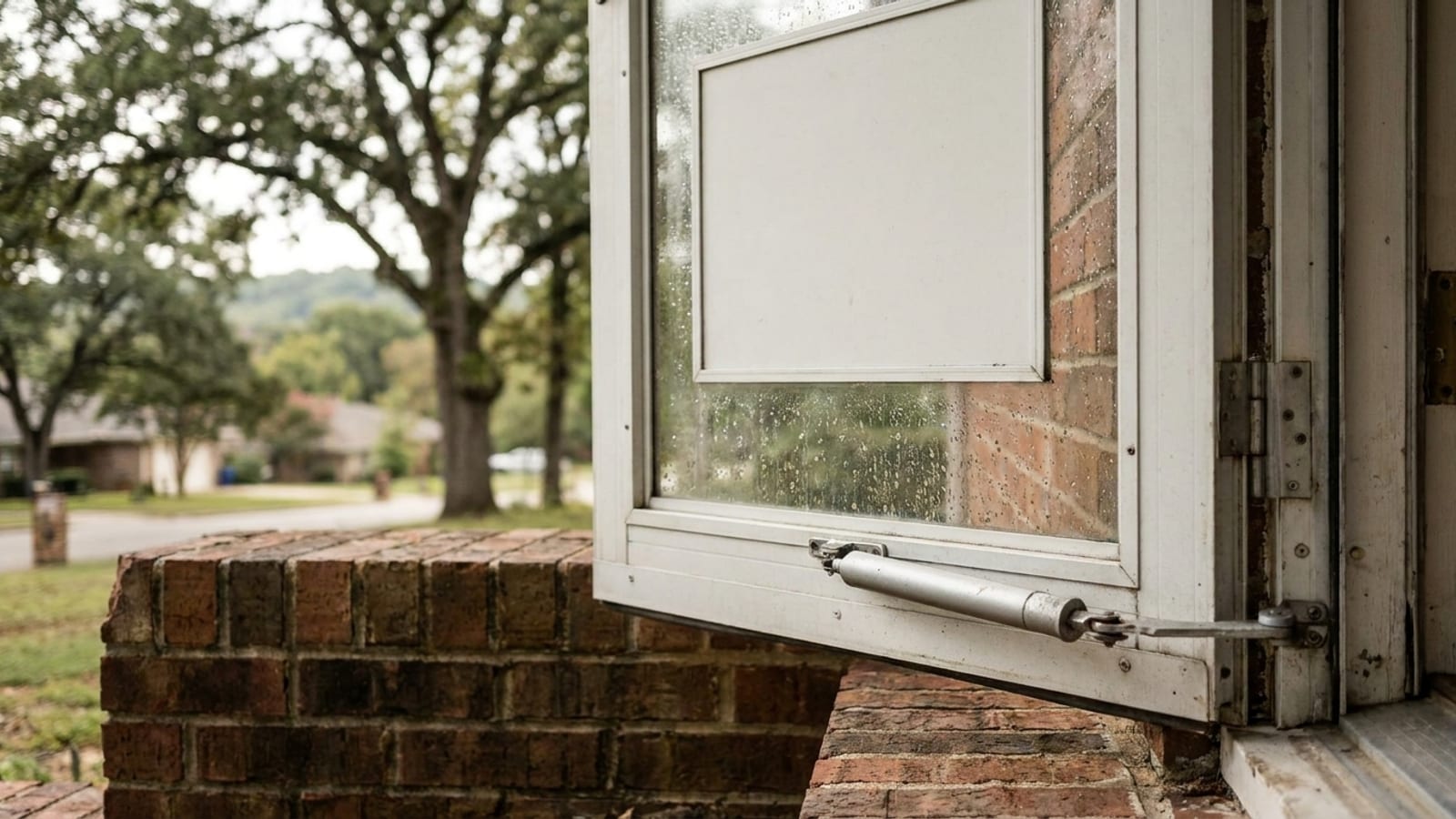
A pneumatic closer is a sealed cylinder with a spring inside and an adjustment screw at the tip. Over years of heat cycling on a south-facing porch, the seal weakens and the cylinder loses the force it needs to finish the swing. The giveaway is a door that closes beautifully to within two inches of the jamb and then just stops, leaving a gap you can see daylight through.
Turn the adjustment screw clockwise in quarter turns and test. If you run out of adjustment and the door still will not seat, the cylinder is spent. Replacement closers are a standard part and take about fifteen minutes.
The hold-open washer is engaged
Every closer rod has a small washer that slides along it. Push it forward against the closer body while the door is open and the door stays open on purpose. That is a feature for carrying groceries in. It is also the single most common reason a homeowner thinks the closer has failed, because the washer gets bumped into position and nobody notices. Slide it back toward the bracket and the door closes normally again.
There is only one closer on a tall door
Most storm doors are designed for two closers, one high and one low. If someone removed the second one, or it was never installed, the door twists slightly as it swings and the latch side arrives at the jamb before the hinge side does. Adding the second closer squares the swing.
Air pressure inside the house
If the door closes fine in the morning and fights you when the HVAC is running, the house is pulling air. A storm door pressed against the main entry door with a tight sweep has very little air path, and a negatively pressurized house will hold it off the jamb. Cracking a window to test this confirms it in about ten seconds.
Why won't the latch catch?
The strike plate is the small metal piece on the jamb side that the latch tongue drops into. It is mounted on slots, which means it is adjustable, and it is almost always the answer.
Close the door slowly and watch where the latch tongue hits. If it is striking above or below the opening in the strike, loosen the screws, shift the plate, and snug it back down. If the tongue reaches the plate but only engages a sliver of it, the strike needs to come out toward the door, which some models allow with a shim behind the plate.
Two other latch failures worth knowing:
- The handle set has loosened. The two halves of a storm door handle clamp through a thin aluminum stile. When those screws back out, the latch body shifts and the tongue no longer extends to full depth. Tighten them evenly from both sides.
- The latch tongue is gummed up. Dirt, pollen and old lubricant turn into paste in a Tennessee summer. A dry lubricant, not an oil, clears it. Oil collects more dirt and you repeat the problem in a year.
Could the frame be the problem?
Storm doors mount to the wood brickmold around your entry door. If that trim has taken on water and softened, the fasteners lose their grip and the whole storm door frame drops a fraction of an inch on the latch side. From the street nothing looks wrong. At the door, nothing lines up.
Check the brickmold with a screwdriver tip at the bottom corners, especially on an entry with no covered porch. If it sinks in, the wood is gone and the storm door is only a symptom. The same water that softened the trim has usually been working on the threshold and the lower jamb of the main door too.
The other frame failure is the door itself racking. Storm doors are light aluminum frames around a glass or screen panel, assembled with corner keys. Years of slamming loosen those corners and the rectangle becomes a parallelogram. You can see it: with the door closed, the gap at the top of the latch side will be noticeably different from the gap at the bottom. Nothing adjusts that back into square.
What does each fix actually involve?
| Symptom | Likely cause | Typical fix | Realistic outcome |
|---|---|---|---|
| Door stops short of the jamb | Weak or worn closer | Adjust screw, then replace the cylinder | Solved, inexpensive part |
| Door stays open on its own | Hold-open washer engaged | Slide the washer back | Solved in seconds |
| Door slams hard | Closer tension too high | Back off the adjustment screw | Solved, no parts |
| Latch will not catch | Strike plate misaligned | Loosen, shift, retighten the strike | Solved, no parts |
| Latch pops open in wind | Shallow strike engagement | Shim or reposition the strike, add a wind chain | Usually solved |
| Door drags on the sill | Sweep set too low or frame dropped | Adjust the sweep, check the brickmold | Depends on the wood |
| Uneven gap top to bottom | Frame racked or trim rotted | Replacement | Hardware will not fix it |
How do you adjust a closer without making it worse?
Small moves and one variable at a time. Quarter turn, test the door, quarter turn, test again. Most people overshoot on the first try, then overcorrect in the other direction and end up with a door that either slams or will not shut.
When there are two closers, set the top one first and get it closing the door reliably, then bring the bottom one in to match. If the two fight each other the door shudders through the last few inches, and that shudder is what loosens corner keys over time.
If your closer has a separate sweep speed and latch speed adjustment, the useful target is slow across most of the swing and a firm last few inches. That is what seats the latch without the bang.
When is the storm door finished?
Replace it when the frame is out of square, when the corner joints have opened up, when the aluminum around the hinge rail has torn out from repeated wind catches, or when the glass panel insert has cracked and the retainer channel is damaged. Also replace it when the brickmold behind it has rotted, because the new door needs something solid to fasten to and that repair happens at the same time.
One honest point: a storm door is a secondary door. If the entry door behind it is drafty, hard to latch, or has a worn threshold, spending money on the storm door first is backwards. Exterior door projects in our market run $3,973 to $7,500 installed depending on configuration, and that number covers the door, the frame, the hardware, the labor and the finish work. Active military, veterans, police, fire, EMS and dispatchers get 50 percent off exterior doors through our Hometown Hero program, which applies to the door itself. Every door we install is backed by The Patriot's Promise in writing.
If spreading the cost matters, we offer financing through the GreenSky program, including no-interest-if-paid-in-full plans and fixed-rate terms, with zero down for most approved homeowners.
What is the next step?
Try the hand-push test and the strike plate adjustment this weekend. They cost nothing and they resolve a large share of storm door complaints. If the gap is uneven top to bottom, if the brickmold is soft, or if you are tightening the same screws every few months, it is time for someone to look at the whole entry rather than the hardware.
Schedule a free in-home estimate at /get-estimate/ and we will measure the opening, check the condition of the trim and threshold, and give you one itemized price for exactly what the entry needs.