Short answer
Compare the two quotes item by item rather than by the number at the bottom, because a lower price almost always means a different product or a different scope. Line up frame material and product series, the glass package including SHGC, whether the job is insert or full-frame, who physically installs it, the warranty term on labor as well as material, and what happens to the old windows and the trim. Once those six lines match, the price difference finally means something.
Two window quotes for the same house almost never describe the same job. One may be an insert replacement in vinyl with a standard glass package, the other a full-frame rebuild with elevation-specific low-E, and the only thing a homeowner sees is that one number is $6,000 lower. Comparing the bottom lines tells you nothing until you have compared the six lines above them.
Here is how to put two estimates side by side and find out what you are actually choosing between.
What should be on every window quote before you compare anything?
A quote you can compare has to be itemized. Not a single lump sum with the word "windows" next to it — a document that names the product, the count, the method and the terms. If one estimate is itemized and the other is one line, you do not have two quotes. You have one quote and one number.
At minimum, both documents should state:
- Manufacturer and product series, by name
- Frame material — vinyl, composite, fiberglass, wood-clad
- Opening count, with sizes and styles per opening
- Glass package, including U-factor and SHGC
- Installation method — insert or full-frame — per opening
- Interior and exterior trim, and what gets wrapped or replaced
- Haul-away and disposal of the old units
- Warranty terms on material and labor
- Timeline from signing to installation
If a line is missing, ask for it in writing before you compare. That is a reasonable request and any company should answer it in a sentence. When you book a free estimate for replacement windows, that itemized sheet is the deliverable — the estimator measures the openings, shows the product, and leaves one honest price. You can request an estimate here and put it next to whatever else you are holding.
Which line items actually explain the price gap?
Most of the difference between two quotes lives in four places. Work through them in this order.
| Line item | What the cheaper quote often has | What that changes |
|---|---|---|
| Frame material and series | An entry-level vinyl line, unnamed | Reinforcement, hardware quality, color options |
| Glass package | One SHGC for the whole house | Summer comfort on west and south elevations |
| Install method | Insert on every opening | Rotted sills and out-of-square frames get covered, not fixed |
| Trim and wrap | Existing trim reused, no capping | Exterior wood left exposed to weather |
| Disposal | Not mentioned | Old units and debris left for the homeowner |
| Warranty | Lifetime material, one year labor | The labor term is what you actually call about |
Frame material and product series
"Vinyl window" covers an enormous range. Two vinyl windows can differ in frame reinforcement, weld quality, hardware, weatherstripping and the number of chambers in the extrusion. That is why the series name matters more than the material name.
We build on the Patriot 3000 and Patriot 7400 series in vinyl and composite, and we are manufacturer-direct on Andersen, MI, Polaris, Vinyl Max, Windsor, Sunrise and HGI. Whatever is on your quote, write down the series and look up its specs. If the quote will not name a series, that is your answer about what is being compared.
Fiberglass is a legitimate upgrade in three specific cases — very wide or tall openings, dark exterior frame colors that absorb heat, and situations where you want the narrowest frame for maximum glass. Expect it to run roughly 40 to 60 percent more per window. If one quote is fiberglass and the other is vinyl, the gap is explained and you are choosing between two real options, not between honest and dishonest pricing.
The glass package
Our entire service area sits in the ENERGY STAR South-Central climate zone. A qualifying window here needs a U-factor of 0.28 or lower and an SHGC of 0.23 or lower. In this climate SHGC is the number that carries the most weight, because our load is cooling, not heating — solar heat coming through the glass is what makes a west-facing room unusable in July.
So look for two things on each quote. First, are the NFRC numbers stated at all? Second, is the glass specified by elevation, or is it the same package on all four sides of the house? The same window does not belong on every side of a house, and a quote that specs by elevation is doing more engineering than one that does not.
Insert or full-frame, per opening
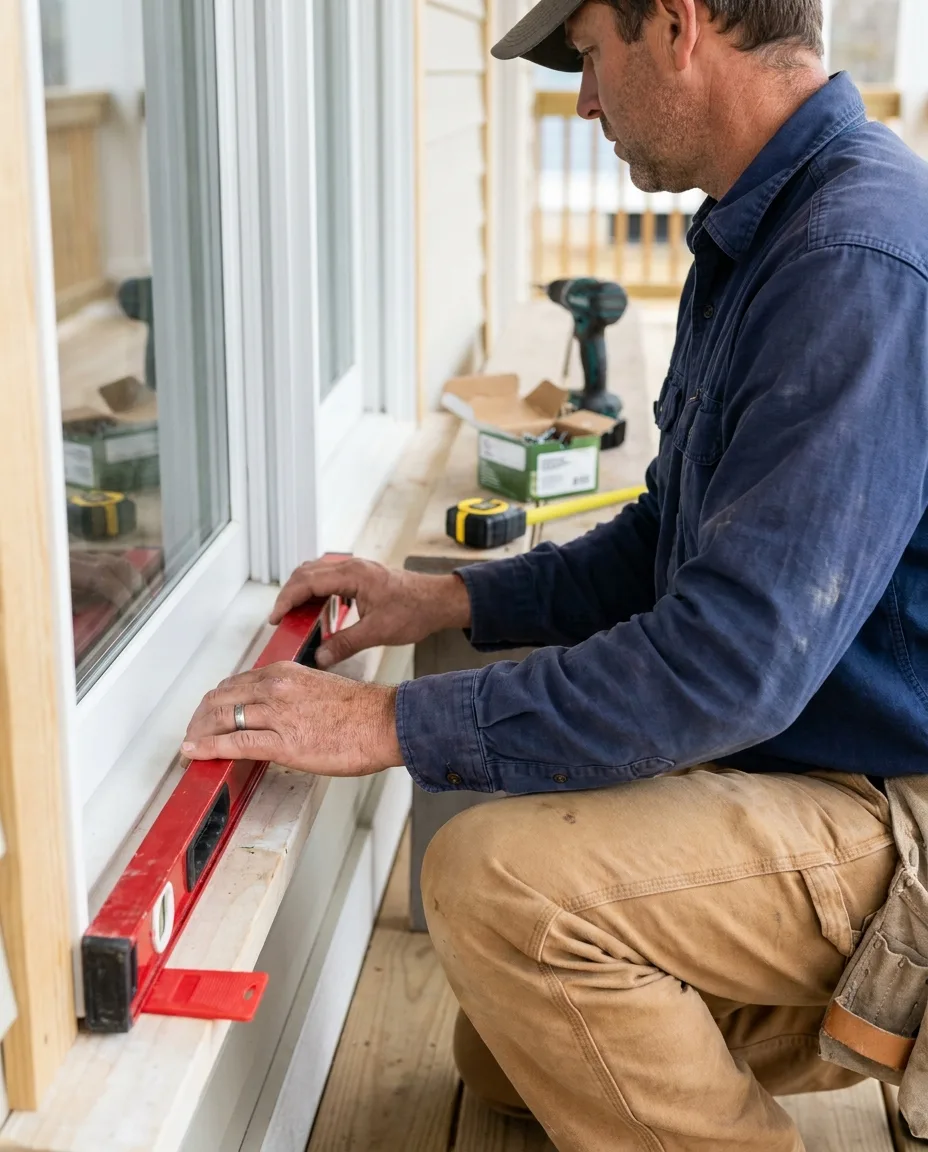
An insert replacement drops a new window into your existing frame. It is faster, cheaper and completely correct when the frame is sound and square. A full-frame replacement removes everything down to the rough opening and rebuilds it, which typically adds several hundred dollars per opening.
Full-frame is the only right answer when a sill is rotted, the frame is out of square, there is a history of water intrusion, or you want to recover the glass area old aluminum frames stole. Many houses correctly get a mix. If one quote is insert on all 14 openings and the other calls for full-frame on the four with soft sills, the second quote is not more expensive — it is more complete.
Trim, wrap and disposal
Ask what happens to the exterior wood after the new unit goes in. Is it capped in aluminum coil, replaced, or left as-is and repainted by you later? Ask the same about interior casing and jamb extensions. And confirm in writing that the old windows and all debris leave with the crew. These are small dollars individually and a real gap between two quotes when they are all missing from one of them.
How do you compare warranties without getting fooled?
This is where the language does the most work. "Lifetime warranty" on most quotes means lifetime on the material only. The labor term is separate and it is frequently one year.
That distinction matters because the calls homeowners actually make are labor calls — a sash that will not lock, a unit that needs adjustment, a seal that failed. Getting the glass free while paying for the visit is a much weaker promise than it sounds.
Our window warranty under the Patriot's Promise covers material and labor for the lifetime of the window, fully transferable one time and prorated after that. When you read the other quote, find the labor number specifically and write it down next to that. Then ask both companies who physically performs the work — an in-house crew or a subcontracted one — and who you call in year seven.
What about who actually shows up on install day?
A quote is a promise about a crew you have not met. Ask both companies directly: are your installers employees or subcontractors, and are the same people who measure the job the ones who install it?
There is nothing wrong with a company having an answer you did not expect, but you should have the answer before you sign, because it explains a lot about how change orders and callbacks get handled. We are a 4th-generation install company rather than a sales and marketing organization, and the owners handle both the front end and the back end so the job does not get handed off and lost. Ask enough questions to know how the other quote is structured too.
Also confirm licensing and insurance in the state where the work is happening. We hold Tennessee license #11022 and carry $2,000,000 liability plus workers' compensation. Ask for certificates, not claims.
Does the payment structure change the comparison?
Sometimes it changes it more than the price does. A quote with a monthly payment printed in large type and the total price in small type is asking you to compare the wrong number. Get both totals, then look at terms.
We finance through the GreenSky® program, with options including no interest if paid in full within 6, 15 or 18 months, a fixed 6.99% APR for 60 months, and longer fixed-rate terms up to 144 months. Zero down for most approved homeowners, subject to credit approval. The details are on our financing page. The point for your comparison is simple: convert both quotes to a total project price first, then decide how to pay for the one you choose.
One more thing worth knowing while you budget. There is no federal tax credit for windows or doors in 2026. The Energy Efficient Home Improvement Credit was terminated for property placed in service after December 31, 2025. Work performed in 2025 or earlier may still be claimable on that year's return — ask your tax advisor. If a quote you are holding builds a federal credit into the math, that math is wrong.
What does a fair comparison look like when you are done?
Make a two-column sheet with these rows and fill in both sides: series name, frame material, U-factor, SHGC, install method per opening, trim treatment, disposal included, material warranty term, labor warranty term, who installs, licensed and insured in your state, lead time from signing, deposit, total price.
When every row is filled, one of two things is true. Either the quotes describe the same job and the price gap is real, or they describe different jobs and you now know exactly which one you want. Either outcome is a good afternoon's work.
A lower number is not automatically a worse company, and a higher number is not automatically better product. What you are looking for is a scope you understand and a price that does not move after you say yes.
Next step
Bring the quote you already have. Our estimator measures your openings, walks the product options with you, and gives one itemized number for the same scope so you can compare like for like. Request your free in-home estimate or call (423) 830-7138.