Short answer
A garden window is a small glass box that projects out past the wall with a shelf inside, and it costs more installed than a flat window in the same opening because you are buying a projecting unit plus the carpentry, flashing and interior finish that go with it. Replacement windows in our market run $700 to $2,200 per window installed, and a garden window sits at the upper end of that per-unit range before the surrounding work is added. It earns its cost over a kitchen sink where you want daylight and a place for herbs, and it is a poor choice on a baking west wall or anywhere the box would project over a walkway.
A garden window is a small glass box that projects out past the exterior wall, with glass on the front, both sides and the top, and a shelf inside for plants. It costs more installed than a flat window in the same opening, because you are buying a projecting unit plus the carpentry, flashing and interior finish that come with anything that sticks out past the siding.
Most homeowners meet a garden window over a kitchen sink, decide they want one, and then find out the price is not in the same neighborhood as the double-hung it is replacing. That is the honest starting point. What follows is where a garden window genuinely earns the money, what it costs, and the four drawbacks worth knowing before you sign for one.
What is a garden window, exactly?
Think of it as a very small bay. The unit projects roughly 12 to 24 inches out from the wall depending on the model, the front glass is fixed, the top is a glass roof, and the two angled side panels are usually operable casement or awning sashes that crank outward. Inside there is one glass or laminate shelf, sometimes two, sitting in the middle of the box.
That shape is what makes it different from every other style in the window catalog. A garden window is not chosen for view or for ventilation. It is chosen because it creates interior shelf space out of thin air, floods a work surface with light from three directions and the top, and gives a kitchen a small greenhouse that does not eat into the counter.
Where a bay or bow window projects far enough to change a room, a garden window projects just far enough to change a sink. It is a single-opening decision, almost never a whole-house one.
What does a garden window cost installed?
Replacement windows in our market run $700 to $2,200 per window installed, and that per-window figure covers the unit, the labor, the sealing and the trim. A garden window sits at the upper end of that range, and then the work around it gets added on top, because a projecting unit is a carpentry job as well as a window job.
Here is what actually moves the number on a garden window quote.
| What drives the price | Why it matters |
|---|---|
| Projection depth | A deeper box is a heavier unit and a bigger cantilever to support and flash |
| Opening size | Wider units carry more glass weight on the same support |
| Condition of the existing sill and framing | Rot found under the old window has to be rebuilt before anything new is set |
| Operable side vents vs fully fixed | Crank hardware on two sides costs more than a sealed box |
| Glass package | Low-E coating, argon fill and warm-edge spacer, specced for the elevation |
| Exterior finish work | Head flashing, siding cuts, trim returns and a sloped sill detail |
| Interior finish work | The shelf, the jamb returns, the apron and the paint-ready edges |
| Support method | Some units need a bracket or a knee support under the box |
Nobody can quote a garden window off a photo, which is why the number comes from a free in-home estimate where the opening gets measured and the sill gets inspected. If the total is more than you planned to spend on one opening, the GreenSky program financing options include no-interest-if-paid-in-full plans and fixed-rate terms, and plenty of homeowners fold a single garden window into a larger window project rather than doing it alone.
Where does a garden window actually work?
Over a kitchen sink
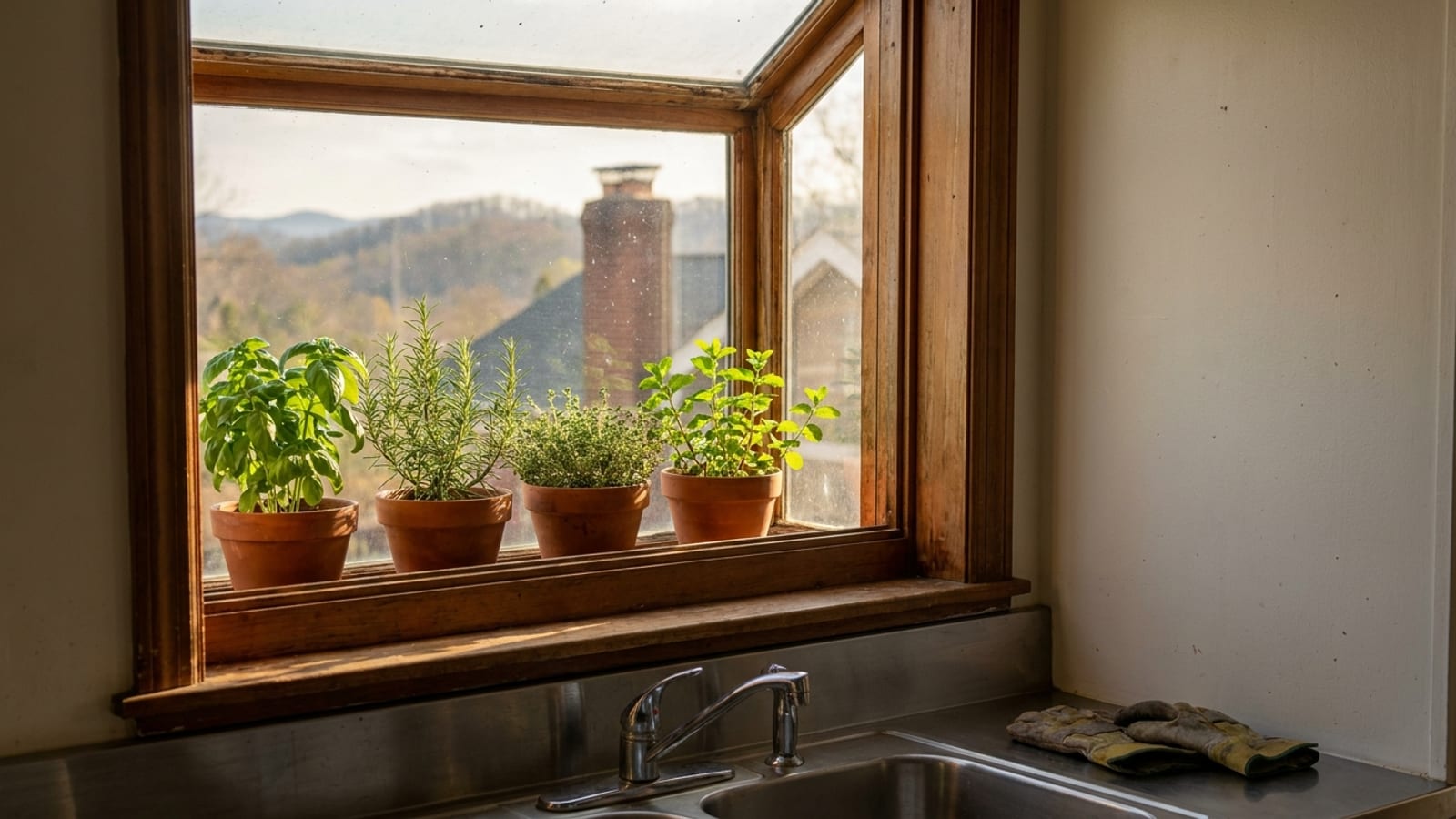
This is the case it was designed for, and it is the one that holds up. The sink wall is already the wall you stand at, the counter already interrupts the room, and the box projects into space nobody was using. You get daylight from four planes instead of one, a shelf that does not steal counter space, and side vents you can crank open while you cook.
On a north or east exposure
Garden windows live or die by exposure. North light is steady and gentle all day. East light warms the box in the morning and lets it cool through the afternoon. Both are excellent for plants and neither turns the kitchen into a heat trap in July.
In a small bath or laundry room
A short garden window high on a laundry room wall adds usable shelf depth in a room that never has enough, and the operable sides exhaust humid air. In a bath, obscure glass in the front and sides keeps the privacy while the shelf holds whatever the vanity cannot.
Where the wall outside is clear
The box has to project into open space. A clear side yard, a planting bed, a blank wall over a driveway apron with clearance — all fine. That sounds obvious until you walk the outside of the house and find the spot you wanted is two feet from a deck rail.
What are the real drawbacks?
Heat gain on the wrong elevation. Our entire service area sits in the ENERGY STAR South-Central climate zone, where a qualifying window needs a U-factor of 0.28 or lower and a solar heat gain coefficient of 0.23 or lower. SHGC is the number that matters most here, because summer cooling load drives the bill, not winter heating. A garden window puts four glazed surfaces including a glass roof on one opening, so a west-facing unit with the wrong glass turns into a solar collector aimed at your kitchen. We spec glass by elevation for exactly this reason; the same glass does not belong on every side of a house.
It projects, so it has to be flashed like a roof. Anything that sticks out past the cladding creates a horizontal top surface and two more water intersections. The head flashing, the siding cut and the slope on the glass roof are what keep that unit dry for thirty years. This is where garden windows installed carelessly fail, and it is the part that has nothing to do with the window itself.
Cleaning is a real chore. Eight glass surfaces counting inside and out, a roof pane you cannot reach from the ground on a second story, and a shelf that collects potting soil. People who love their garden window still say this out loud.
No egress, limited ventilation. The only opening area is the two side vents. That is enough to move air in a kitchen and nowhere near enough for a bedroom escape route.
How does a garden window compare to the alternatives?
| Garden window | Bay or bow | Double-hung | Picture with side vents | |
|---|---|---|---|---|
| Projects past the wall | 12 to 24 inches | Much farther, often with a roof and floor | No | No |
| Adds interior shelf space | Yes, that is the point | Adds a seat or a ledge | No | No |
| Ventilation | Two side vents only | Depends on the flankers | Half the opening | Side vents only |
| Best location | Over a kitchen sink | Living room, dining room, bedroom | Almost anywhere | Where view matters most |
| Relative installed cost | Upper end of the per-window range, plus finish work | Highest of the four | Lowest | Moderate |
| Meets egress | No | Sometimes, if a flanker is sized for it | Often, when sized for it | No |
What does installation day look like?
The crew protects the counter and the floor, pulls the old unit, and inspects the sill and framing before anything new goes in. Any soft or water-damaged wood gets rebuilt at that point, because a cantilevered box has to bear on sound material. The unit is set level, plumb and square, fastened into framing, supported underneath if the model calls for it, then air-sealed, flashed at the head and sides, and trimmed outside and inside. The shelf and the interior returns are the last step.
One opening is usually a single day. When your jurisdiction requires a permit, we pull it through the local building department as part of full service. The finished job carries our lifetime material and labor warranty under the Patriot's Promise — read the labor term on any quote you compare, because a lifetime material warranty paired with a one-year labor warranty is a much weaker promise than it sounds on a unit with this much flashing detail.
Is a garden window the right call for your kitchen?
Yes, if the sink wall faces north or east, the outside of that wall is clear, and you actually want the shelf. Probably not, if the wall takes hard west sun, if the box would hang over a walkway or crowd a deck, or if what you really want is a bigger view — in which case a larger picture unit with operable flankers gives you more glass for less money and no roof to flash.
The next step is a free in-home estimate. An estimator measures the opening, checks the sill and framing, looks at what is outside that wall, walks the glass options for that specific exposure, and gives you one itemized number. It is a sales appointment, and it is also the only way anyone can hand you a real price instead of a guess. Request an estimate and we will come look at the opening.