Short answer
Rescreening the frame you already own runs roughly $15 to $40 in materials, or about $40 to $90 if a local shop does it, while a stock replacement panel generally costs $60 to $150 and a custom panel built to your opening lands closer to $150 to $250. Those are general market ranges for the screen itself, not a quote on your door. If a new screen still will not roll or stay in the track, the frame or the track is the actual problem and the screen is only the symptom.
A patio door screen is one of the least expensive repairs on the exterior of a house. Rescreening the frame you already have costs roughly $15 to $40 in materials if you do it yourself and about $40 to $90 if a local shop does it, a stock replacement panel usually runs $60 to $150, and a custom panel built to your measured opening generally lands between $150 and $250. Those are general market ranges for the screen itself. What changes the math is whether the screen is actually the broken part.
Plenty of homeowners buy two or three screens for the same door over a few years and never fix the reason the first one failed. Before you spend anything, it is worth separating a torn screen from a worn track, a racked frame, or a patio door that has moved enough that nothing riding in it will run straight again.
What does a patio door screen cost to replace?
Here is how the options stack up, from the cheapest fix to the one that replaces the whole assembly.
| Approach | What you get | Typical cost |
|---|---|---|
| Rescreen your own frame | New mesh and spline in the existing frame | $15 to $40 in materials |
| Rescreen at a local shop | Same, done for you, frame squared up | $40 to $90 |
| Roller and hardware kit | New rollers, pull handle, latch, top guides | $10 to $40 in parts |
| Stock replacement screen panel | Prebuilt panel in a common size, adjustable height | $60 to $150 |
| Custom screen panel built to measure | Panel sized to your exact opening and track profile | $150 to $250 and up |
| New sliding patio door installed | Door, frame, hardware, screen, labor and finish work | $3,973 to $7,500 (our installed door range) |
The first five rows are market ranges that move with mesh type, panel size and who does the work. The last row is our own installed range for a door project, and it is there for scale: a screen is a small number, a door is a project, and knowing which one you are looking at is the entire point of diagnosing before you buy.
Can you rescreen the frame you already have?
If the aluminum frame is straight, the corner keys are tight and the rollers still turn, rescreening is the right call. The job is simple. You pry the old spline out of its groove with a screwdriver, lift out the torn mesh, lay new mesh over the frame, and roll it into the groove with a spline roller while keeping light, even tension. Trim the excess with a utility knife against the outside of the spline.
Two things go wrong for first-timers. One is pulling the mesh drum tight, which bows the frame inward and guarantees the panel binds in the track. The other is reusing old spline that has hardened, which will not hold the mesh for long. New spline costs a couple of dollars and matching the diameter matters more than the brand.
Rescreen when the frame is sound. Replace the panel when a corner has separated, when the frame has a visible bow you can see by sighting down the edge, or when the bottom rail is worn through where the rollers mount.
Which screen mesh should you choose?
Mesh is a real decision on a patio door because that panel gets touched, leaned on and pushed through more than any window screen in the house.
Standard fiberglass
The default. Inexpensive, flexible, easy to install, and it does not crease permanently the way metal can. It is also the easiest to tear, which is why it is the mesh most often being replaced.
Aluminum
Stiffer and more tear resistant than fiberglass, and it holds a flat plane well on a tall panel. The downside is that once it dents or creases, the dent is permanent and visible from across the yard.
Pet-resistant mesh
Heavy vinyl-coated polyester strands, several times the tear strength of standard fiberglass. Worth it on any door a dog uses as a doorbell. It cuts a little more light and airflow and costs more per square foot.
Solar or sun-blocking mesh
A tighter weave that blocks a meaningful share of solar heat and glare on a west-facing door. It darkens the view out, which some homeowners like and some do not. On a door that bakes every afternoon it takes real load off the room, though the glass package in the door itself does far more.
No-see-um mesh
A finer weave for gnats and small insects, common near creeks and wooded lots. Airflow drops noticeably compared with standard mesh, so use it where the bugs justify it.
Why does the screen keep coming off the track?
A screen panel that will not stay put almost never has a screen problem. Work through this order before you buy anything.
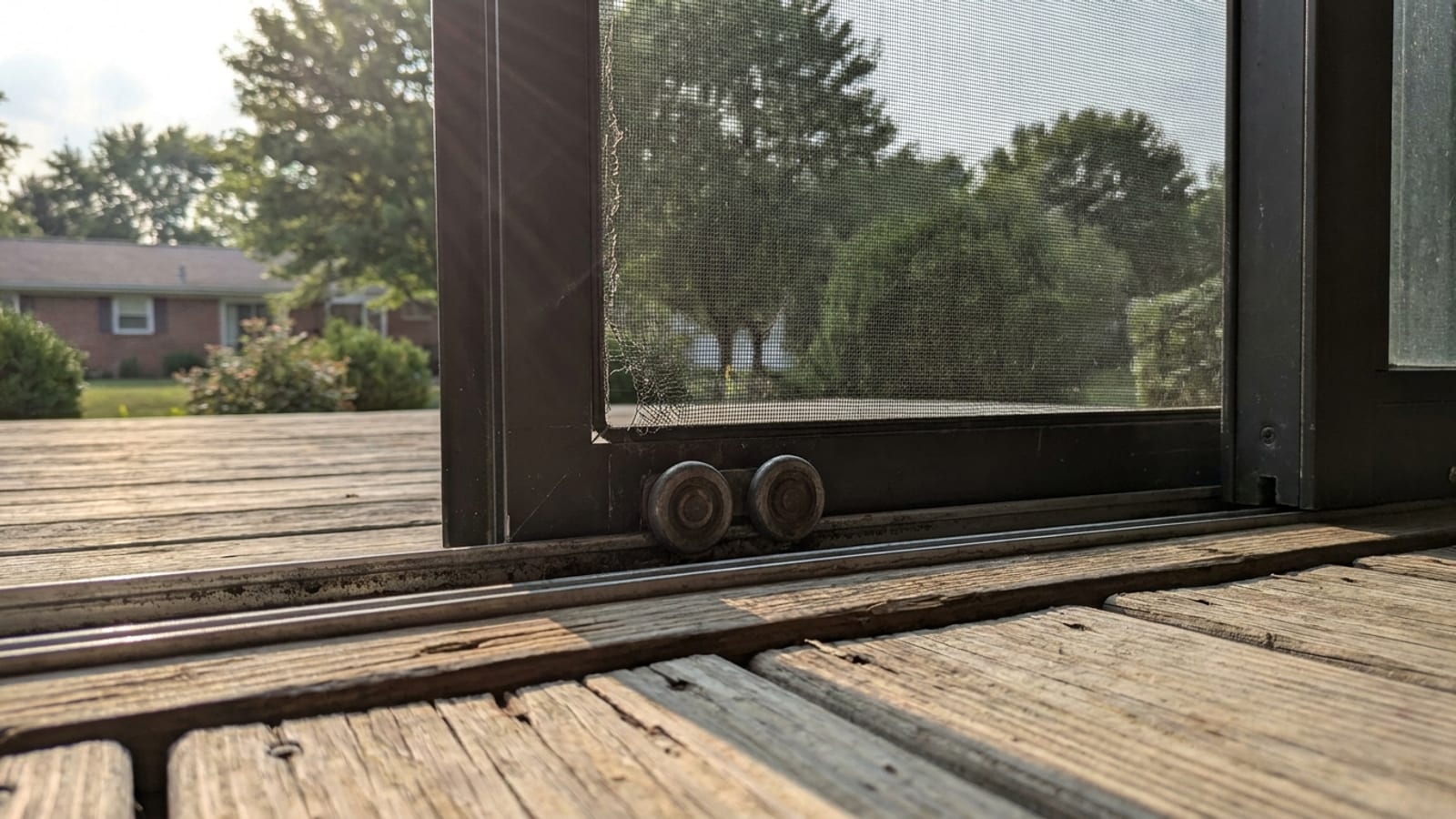
- Clean the track. Grit, mulch, pet hair and dried mud pack into the bottom channel and lift the rollers out of their path. A vacuum, a stiff brush and a dry silicone lubricant solve more sticking screens than any part you can order.
- Check the rollers. Flat spots, seized wheels or a roller that has worn to the axle will drag. Most screen panels have adjustment screws at the bottom corners that raise or lower the wheel. A full roller kit is inexpensive.
- Look at the top guide. The upper channel keeps the panel vertical. If it has been bent by someone forcing the screen, the panel will pop out every few days until the channel is straightened or replaced.
- Sight down the frame. If the screen frame is bowed or a corner has opened up, the panel is no longer square and nothing you adjust will make it ride correctly.
- Test the main door. If the glass panel is also hard to slide, the problem is the door, not the screen.
When is the screen telling you the door needs replacing?
A screen is the lightest moving part in the assembly, so it reports trouble first. Treat these as door signals rather than screen signals.
- The bottom track is bent, crushed or worn through its metal cap, so both the screen and the main panel ride on a damaged surface.
- The frame has racked enough that the gap between the panel and the jamb is wider at the top than the bottom.
- The glass in the main panel is fogged between the panes, which means the insulated glass seal has failed and no cleaning reaches it.
- You feel air and see daylight at the meeting stile with the door fully closed and latched.
- You have already replaced rollers on both the screen and the door and both are dragging again within a year.
One of those is a repair conversation. Three of them means the assembly is finished, and new screens are money spent on a door that is on its way out. Our installed door range of $3,973 to $7,500 covers entry, patio, French and storm doors, with the spread driven by configuration, glass and what the crew finds at the threshold once the old unit comes out. Every door we install is backed by The Patriot's Promise in writing, material and labor both.
Does a new patio door include a screen?
Most sliding patio door configurations include a screen panel, but it belongs on the quote as its own line rather than being assumed. Screen type is also a specification worth making on purpose. If you have a dog, order the heavy mesh at the factory instead of rescreening a brand new panel six months later. If the door faces west, ask about solar mesh alongside the glass package, because the two work on the same problem from different directions.
French door configurations handle screens differently. Some use a retractable screen that rolls into a housing at the jamb, which keeps the clean look of the door when the screen is not in use but adds a mechanism that needs its own care. That is a decision to make at the order stage, not afterward.
We are manufacturer-direct on the doors we carry, and we will also install owner-supplied doors to manufacturer specification, which most companies will not do. If you have already bought a door or a replacement panel somewhere else, bring the order details so we can confirm the sizes fit the opening.
What should you measure before ordering a panel?
Measure three things and write them down before you call anyone.
- Height. Top of the upper channel to the top of the bottom track, in three places across the opening. Use the smallest number.
- Width. Inside the screen track opening, again in three places.
- Track profile. Photograph the bottom track straight on. The shape of that channel decides which roller and panel styles fit, and it is the detail that trips up mail-order screens most often.
If the three height measurements differ by more than a quarter inch, the frame has moved, and a stock adjustable panel is likely to fight you no matter how carefully you order it.
What to do next
If the frame is straight and the track is clean, rescreen it and get on with your weekend. If the panel keeps derailing, the main door drags, or the glass has fogged, have someone look at the door as a whole before you buy another screen. Schedule a free in-home estimate and we will measure the opening, check the track and threshold, and give you one itemized number. It is a sales appointment, and it is also the only way to get a real figure instead of a guess. You can also reach either office through our contact page.