Short answer
Most of a front door's security lives in the strike plate, the hinges and the wall framing behind them, not in the door skin. A Grade 1 or Grade 2 deadbolt anchored with three-inch screws into framing resists a kick far better than an expensive door held by a short-screw strike. Pick the lock grade first, the finish for your exposure second, and settle any multi-point or smart hardware before the door is ordered.
A front door is a system, and the lock is only as strong as the wood it is fastened to. Homeowners spend their entire hardware budget on the deadbolt and then leave a strike plate held by two three-quarter-inch screws that bite nothing but the jamb trim. That is the part that gives way. Before you compare finishes or shop smart locks, understand what a forced entry actually breaks and where the money buys real resistance.
Everything below applies to any entry door we install, and most of it applies to the door you already have.
What actually fails when a front door gets forced?
It is almost never the door skin. Fiberglass and steel entry doors have solid cores and reinforced lock blocks, and a kick does not punch through them. What fails is one of three things.
The jamb splits at the strike. A short screw only holds the one-inch-thick jamb board, so the whole strike tears out with a chunk of pine attached to it.
The hinge side lets go. Same problem, opposite edge. Factory hinge screws are often short enough that they stop in the jamb instead of reaching the framing behind it.
The bolt is too short or the deadbolt is a low grade. A bolt that only projects half an inch has very little jamb to hold onto, and a light-duty cylinder can be twisted or bumped more easily than a rated one.
All three are fixable with hardware and fasteners that cost very little relative to the door.
What do deadbolt grades actually mean?
Locks are graded by ANSI and BHMA, and the grade is a durability and force-resistance rating, not a marketing tier. It is printed on the box.
| Grade | What it is built for | Typical use | Bolt throw |
|---|---|---|---|
| Grade 1 | Highest residential and commercial rating, most cycles, most force and pick resistance | Main entry doors, any door with limited street visibility | One inch |
| Grade 2 | Solid residential duty, good force resistance, fewer cycles | Secondary exterior doors, side and garage-to-house doors | One inch |
| Grade 3 | Basic residential minimum | Low-traffic or interior locking doors | Often shorter |
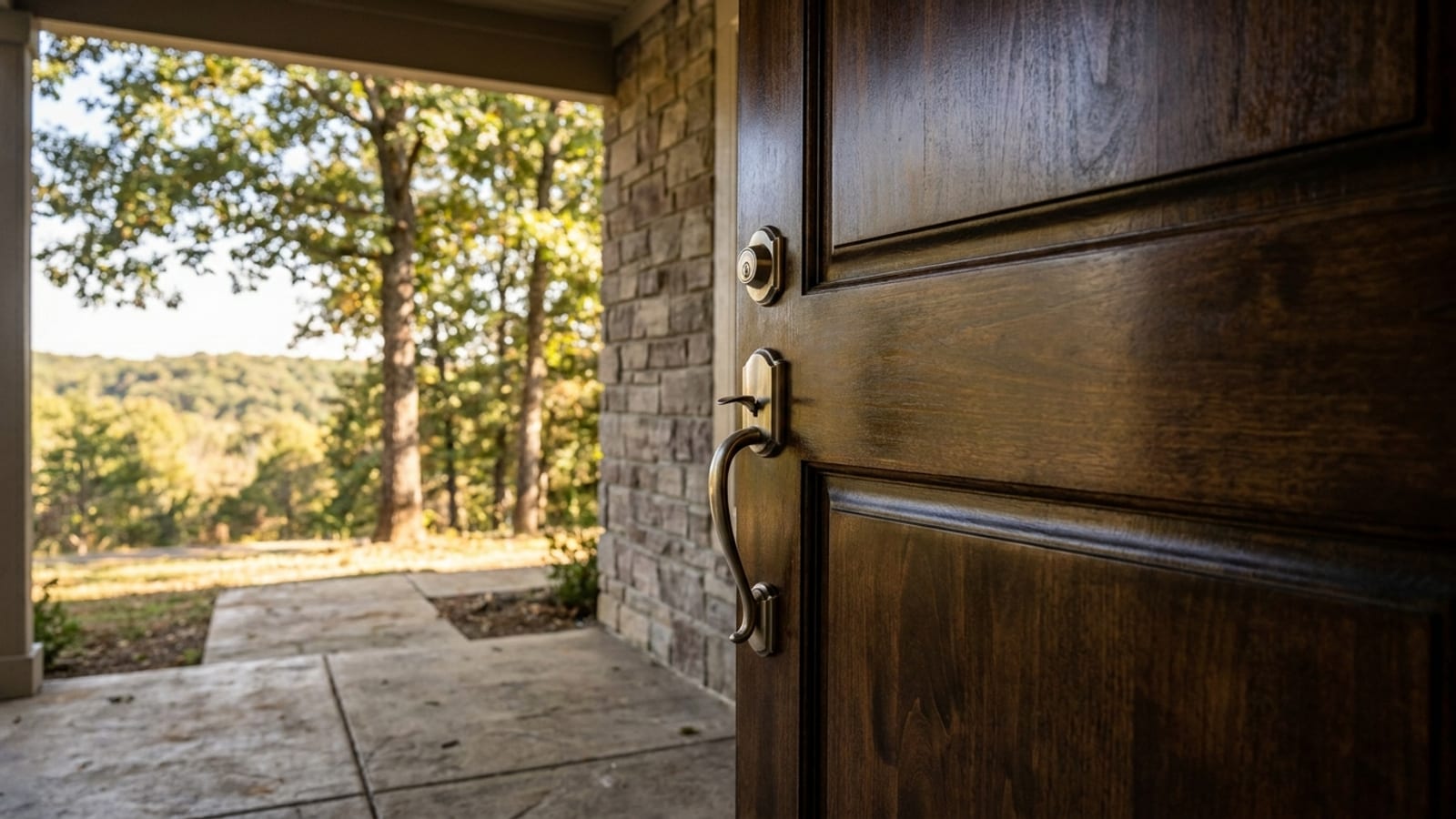
For a front door, Grade 1 or Grade 2 with a full one-inch throw is the sensible floor. Beyond the grade, look for a hardened steel insert in the bolt, a reinforced cylinder collar that resists wrenching, and an anti-drill plate. Keyway technology matters less than most people think once the bolt and strike are right.
What is the cheapest security upgrade on any front door?
The strike plate and the screws behind it.
A box strike, meaning one with a metal cup that surrounds the bolt rather than a flat plate with a hole, distributes force across the jamb instead of concentrating it at the edge of the mortise. Pair it with screws that are three inches long so they pass through the jamb, through the shim space and into the king stud in the wall framing. That one change moves the failure point from a piece of jamb trim to structural framing, and it is the difference between a door that pops open and one that holds.
Do the hinges the same way
A door forced on the hinge side fails the same way for the same reason. Replace one screw in each hinge leaf on the jamb side with a three-inch screw. Three hinges, three screws, and the hinge side is now anchored to framing. We do this as part of the install rather than treating it as an add-on, because it takes a few minutes and it is the correct way to hang an exterior door.
Do multi-point locks make a real difference?
They do, and for two reasons that are not equally obvious.
The security reason is straightforward: instead of one bolt at the middle of the door, a multi-point system throws bolts or hooks near the top and bottom of the slab as well when you lift the handle and turn the key. Force applied anywhere on the door is resisted at three points instead of one.
The sealing reason matters more day to day. Pulling the door tight at the top, middle and bottom compresses the weatherstripping evenly the whole height of the slab. Tall doors and doors in direct sun can bow slightly with temperature swings, and a single center bolt lets the corners drift away from the seal. If you have ever seen daylight at the top corner of a closed door, that is what a multi-point set fixes.
The tradeoffs: it costs more, the door has to be factory-prepped for that specific system, and it is not something you retrofit later on a whim. It is a decision made at the order, not after install.
Are smart locks a good idea on an entry door?
They are fine, with conditions. A smart deadbolt from a reputable maker carries the same ANSI grading as a mechanical one, so start by checking the grade rather than the app features. What people actually value is keyless entry for kids and contractors, remote lock checking, and codes you can delete when a job is done.
What to think through before you buy one:
- Batteries. Everything battery-powered eventually goes dead. Look for a low-battery warning and an external contact or key override.
- Exposure. A lock on an unprotected west-facing door takes sun, driving rain and the humidity swings we get here. Check the manufacturer's exterior rating rather than assuming.
- Keyed backup. A model with a mechanical key cylinder is the safer choice on a primary entry.
- Prep compatibility. Standard bore and backset make later swaps easy. Nonstandard prep locks you into one product family.
- Handing and hardware match. Smart deadbolts are usually a separate purchase from the handleset, so finishes need to be selected as a pair.
How do hardware finishes hold up in Southeast humidity?
Humidity, pollen, afternoon storms and direct sun are hard on exterior trim hardware. The finish process matters more than the color name.
| Finish type | How it wears outside | Best fit |
|---|---|---|
| PVD or physical vapor deposition | Very hard, resists tarnish and UV, usually carries the longest finish warranty | Unprotected doors, sunny and west-facing entries |
| Powder coat, typically matte black or bronze | Durable, may fade or chalk slowly under constant sun | Most entries, especially covered ones |
| Lacquered brass or plated finishes | Softens and spots faster where sun and rain hit it directly | Covered porches and protected entries |
| Living or unlacquered finishes | Deliberately patinas and changes over time | Homeowners who want the aged look |
If your entry has no porch cover, spend the money on the finish process rather than on the style. A handleset that pits and clouds in three years undoes the look of a new door faster than anything else on the elevation.
What hardware decisions have to be made before the door is ordered?
Several, and this is where a rushed order causes problems later.
- Handing. Which way the door swings and which side the hinges are on. Hardware is handed on many handleset styles.
- Bore and backset. Standard is a 2-1/8 inch bore with a 2-3/8 or 2-3/4 inch backset. Nonstandard prep limits future lock choices.
- Single lock versus multi-point. Factory prep, not field work.
- Deadbolt configuration. Single-cylinder is the default. Double-cylinder is restricted in some jurisdictions and creates an egress problem in a fire.
- Keying. Keyed-alike sets across the front, back and garage entry doors are simple to specify up front.
- Glass proximity. If the door or sidelight has glass within reach of the lock, laminated safety glazing is the better answer than a key-inside deadbolt.
Getting these right at the estimate is part of why the visit includes measuring the opening and walking the actual product with you, and why the number you get is itemized rather than a rough guess.
What does good hardware cost as part of the project?
A replacement entry door installed runs about $3,973 to $7,500 in our market, and that figure includes the door, the frame, the hardware, the labor and the finish work. Hardware moves that number less than glass, sidelights or transoms do. Stepping up from a builder-grade lockset to a Grade 1 deadbolt, a solid handleset and a box strike is one of the better value decisions on the whole quote.
Both the product and the workmanship are covered in writing under the Patriot's Promise, material and labor. If you would rather spread the project out, we offer financing through the GreenSky program, including no-interest-if-paid-in-full plans and fixed-rate terms. Active military, veterans, police, fire, EMS and dispatchers get 50 percent off exterior doors through our Hometown Hero program — bring proof of service to the estimate and it comes off the quote.
What to do next
If your current door still closes and seals well, start with the two cheap fixes: a box strike and three-inch screws at the strike and hinges. If the door itself is worn, drafty, dented or hard to lock, the hardware conversation belongs inside a door replacement conversation instead.
Schedule a free in-home estimate and we will measure the opening, look at the jamb and framing condition, show you the hardware options in person, and give you one itemized price with the install method spelled out. It is a sales appointment, and it is also the only way to get a real number for your door instead of a range.