Short answer
Seal it first — most drafty front doors are a compression problem, and new weatherstripping, a fresh door sweep, a threshold adjustment or a repositioned strike plate solve the majority of them for very little money. Replace the door when the parts are not the problem: rot in the slab, sill or jamb, a warped slab, a racked frame, or a hollow builder-grade door with no real insulating core. The dividing line is whether the seal failed or the door did.
A drafty front door is a seal problem far more often than a door problem. New weatherstripping, a fresh sweep, a threshold adjustment or a strike plate moved an eighth of an inch will fix the majority of drafty entries in this region for very little money. Replace the door when the failure is structural rather than in the parts — rot in the bottom rail, sill or jamb, a slab that has warped away from the stop, a frame that has racked out of square, or a thin builder-grade unit that never had much of an insulating core to begin with.
The useful question is not "is my door old." It is "what specifically is letting air through, and is that thing replaceable on its own." Work that out first and the seal-or-replace decision usually makes itself.
Why is my front door drafty in the first place?
An entry door only seals because it compresses against something. Four things create that compression, and a draft means one of them has quit.
The weatherstripping has taken a set
The foam or bulb seal in the jamb kerf is designed to squash when the door closes and spring back when it opens. After enough summers of Tennessee Valley heat and enough winters of cold, it stops springing back. It looks fine — it is just flat. Press it with a thumbnail. If it does not push back, it is no longer sealing regardless of how it looks.
The sweep or threshold no longer touches
The bottom edge is the hardest joint on any door because it is the one you walk over. Sweeps wear through at the traffic point first, usually right in the middle. Thresholds wear at the cap. If you can see daylight along the bottom on a bright morning, that is the leak, and it is often the biggest one in the whole opening.
The door has moved out of square with the frame
Houses settle, hinge screws loosen into soft framing, and a door starts hitting the stop at the top and standing off at the bottom, or vice versa. You can feel this before you see it: the door needs a shove at one corner, or the latch only catches if you pull the knob toward you.
The lock side is not pulling tight
A strike plate that has drifted, or a latch that just barely catches, holds the door in the frame without pulling it against the weatherstrip. The door is closed. It is not sealed. This is one of the most common causes of a draft on an otherwise sound entry.
How do I find the leak before I spend money?
Three checks, all free, all worth doing before anyone quotes you anything.
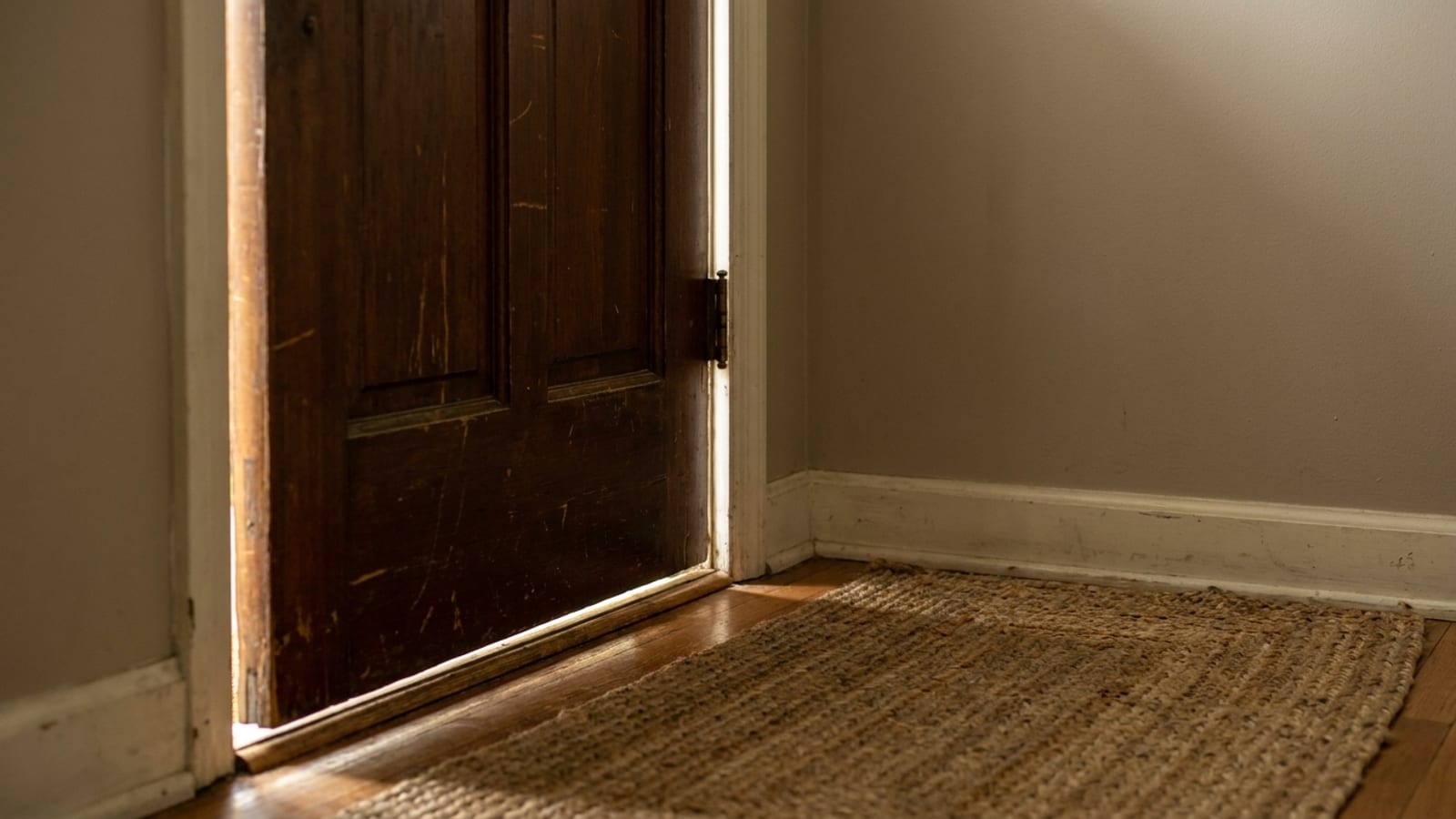
- The daylight test. Stand inside on a sunny day with the lights off. Any light along the perimeter is an air path. The bottom and the hinge side show it first.
- The paper test. Close the door on a dollar bill and pull. If it slides out with no drag, there is no compression at that point. Repeat it every foot around the whole perimeter — most doors seal at some points and not others.
- The hand test on a windy day. Run the back of your hand slowly around the frame, then along the bottom, then at the corners. Cold moving air is easy to feel and hard to argue with.
One more thing to rule out: air coming from under the baseboard or the casing rather than from the door itself. That is a gap between the door frame and the rough opening, hidden behind trim, and it is an insulation and air-sealing issue rather than a door issue. It is also one of the things a proper installation closes for good, because the perimeter gets insulated and air-sealed before the trim goes back on.
Seal it or replace it — how do I decide?
| What you find | Most likely cause | The honest call |
|---|---|---|
| Flat, hard weatherstrip; door closes easily | Seal has taken a set | Seal — replace the stripping |
| Daylight along the bottom | Worn sweep or dropped threshold | Seal — new sweep, adjust threshold |
| Latch barely catches; draft on lock side | Strike plate drifted | Seal — reposition the strike |
| Door drags at top corner | Loose hinge screws, sagging | Seal — longer hinge screws, shim |
| Screwdriver sinks into bottom rail or jamb | Rot from standing water | Replace |
| Slab is bowed; won't touch the stop | Warped door | Replace |
| Gaps are wide at top, tight at bottom | Frame is racked | Replace the unit, not the slab |
| Hollow feel, thin panel, no real core | Builder-grade door | Replace |
| Fogged or cracked glass in the door | Failed insulated glass in the lite | Replace |
| Already re-sealed once and still drafty | The parts were not the problem | Replace |
The pattern is straightforward. If the failure is in something you can buy at a hardware store and screw on, seal it. If the failure is in the wood, the shape or the core, no amount of weatherstripping puts it back.
What does replacing the door actually solve?
A new entry door replaces the whole assembly, not just the panel. That matters because the frame, the sill and the threshold are where most of the leaking is happening on an old door. A properly set unit is plumb and square in the opening, shimmed at the hinges and the strike, insulated and air-sealed around the perimeter, and flashed and finished at the threshold so water sheds outward instead of soaking into the subsill.
Modern entry doors also start from a better place thermally. An insulated fiberglass or steel core with factory weatherstripping and a compression threshold seals in a way a solid slab of 1970s wood never did, and the hardware pulls the door tight rather than merely holding it shut. That is the difference people notice in the first cold snap — not a number on a bill, but a hallway that stops being the cold room in the house.
What does a new entry door cost, and how do people pay for it?
A replacement entry door installed runs about $3,973 to $7,500 in our market. That is a complete number covering the door, the frame, the hardware, the labor and the finish work. Where a project lands in that spread depends on material, how much glass is in it, whether you are adding sidelites or a transom, and what condition the opening and threshold are in once the old unit comes out.
If you are active military, a veteran, police, fire, EMS or a dispatcher, the Hometown Hero program takes 50% off exterior doors. It is a standing program rather than a seasonal promotion, it applies to the door itself, and it does not stack with other offers — bring proof of service or a department ID to the estimate. For homeowners spreading the cost, financing runs through the GreenSky® program, including no-interest-if-paid-in-full plans at 6, 15 or 18 months and fixed rates starting at 6.99% APR, with zero down for most approved homeowners.
The workmanship side is worth asking about on any door quote, not just ours. A material warranty with a thin labor term is a weaker promise than it sounds, because door service calls are usually about how the unit was set, adjusted and sealed. Ours is written out in The Patriot's Promise with material and labor both named.
If I do replace it, steel or fiberglass?
Exposure decides this more often than budget does. Steel is strong, well insulated and the more affordable of the two, and it is a good fit under a deep covered porch where the door is not taking weather directly. Fiberglass does not dent, rot or rust, handles direct sun and driving rain, and gives a convincing wood-grain look, which makes it the safer pick on a west- or south-facing entry with little cover. If your current door is drafty and the finish is chalked from sun exposure, that is the elevation telling you which material it wants.
Wood is the premium look and the highest maintenance, and it is the material most likely to be behind a draft in the first place, because a wood slab moves seasonally and swells with humidity.
What should I do first?
Do the paper test and the daylight test this week. If every gap you find is at the sweep, the strike or a flat piece of weatherstrip, buy the parts and close them — that is an afternoon and it is the right answer. If your screwdriver finds soft wood at the bottom of the jamb, if the slab is bowed, or if you have already re-sealed the thing once and it is still cold in the hall, the door is done and sealing it again just buys another season.
When you are at that point, book a free in-home estimate. An estimator measures the opening, checks the sill and framing condition, walks the material and glass options with you, and gives you one itemized price with the install method spelled out. It is a sales appointment, and it is also the only way to get a real number instead of a guess about what is under your threshold.