Short answer
A double-hung sash that will not stay open has a failed balance — the spring or cord system hidden in the jamb that counteracts the weight of the sash. On a sound window the balance can usually be replaced for a modest cost, and that is the right first move. It becomes a replacement conversation when the frame is out of square, the sash or sill is rotted, the glass has fogged between the panes, or the balance parts for that unit are no longer made.
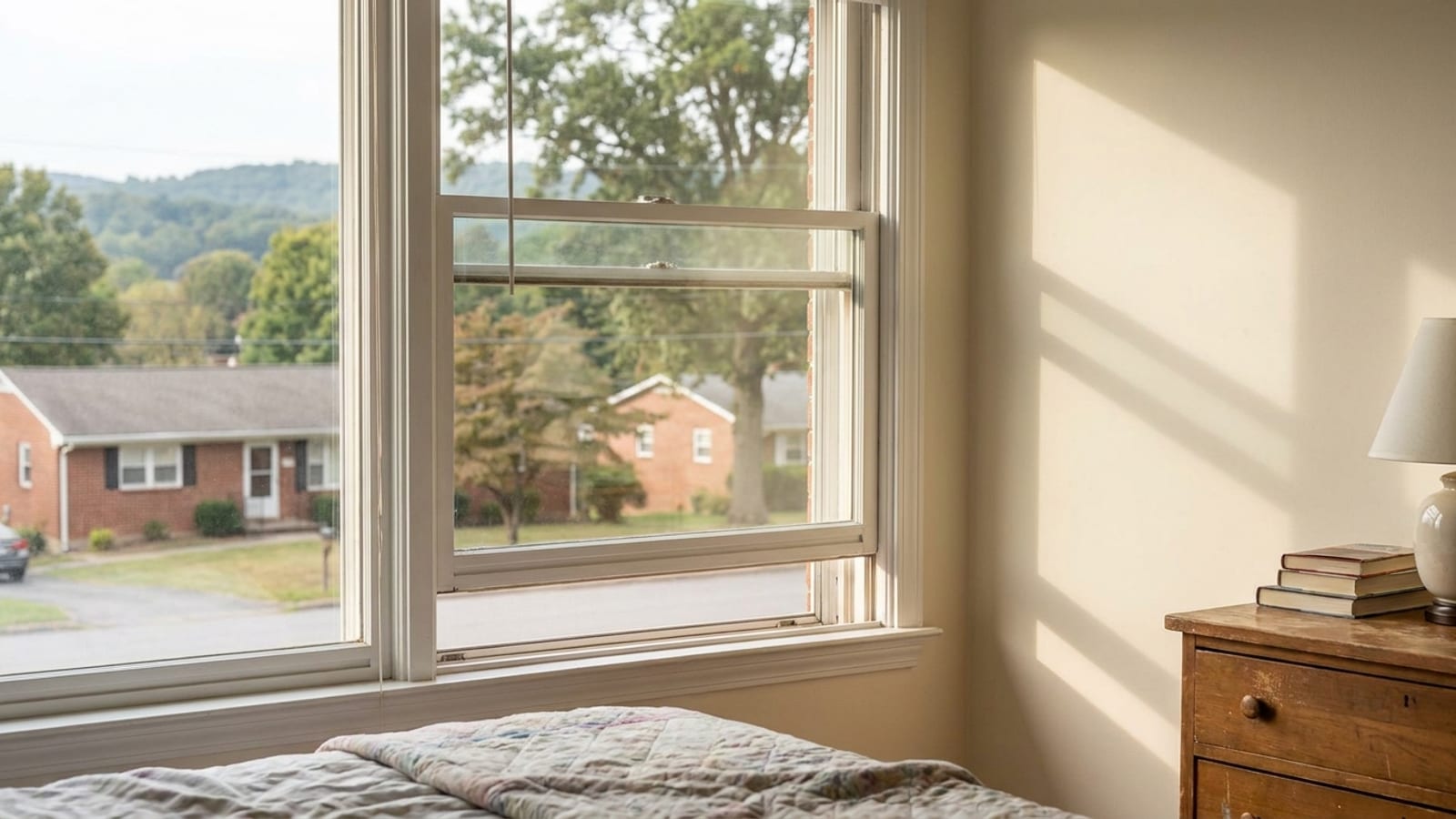
A double-hung sash that slides shut the moment you let go of it is almost never a mystery. The window has a balance system hidden in each side jamb whose only job is to offset the weight of the sash, and when one side lets go, gravity wins. Nothing is wrong with the glass, the lock or the way the window was hung. A spring has lost tension, a cord has frayed, or a plastic clip has broken.
That is good news most of the time, because balances are replaceable parts. The question worth answering before you spend anything is whether you have a parts problem or a window problem, and those look identical from across the room.
What actually holds a double-hung sash up?
Every operable double-hung uses some mechanism to counterweight the sash. Which one you have depends on when the window was built.
Weight and pulley. Original to most homes built before roughly 1950. A cast iron weight hangs on a cord inside a pocket in the wall, running over a pulley at the top of the jamb. When the cord breaks — and cotton cord always eventually breaks — the weight drops to the bottom of the pocket and the sash goes dead. These are repairable if the pocket cover is accessible, and the open weight pocket itself is a permanent hole in the insulation of your wall, which is one reason older homes are a different job entirely.
Spiral balance. A twisted steel rod inside a tube, common on wood and aluminum windows from the 1960s through the 1980s. They can be re-tensioned by turning the rod, and they can also be re-tensioned incorrectly, which is how a sash ends up floating up on its own.
Block and tackle. A small pulley system with a coiled spring inside a channel, standard on a lot of vinyl replacement windows. When the cord or the spring goes, the sash drops.
Constant force coil. A flat coiled steel spring, like a tape measure, clipped into the jamb. Simple, durable, and cheap to replace when the coil finally relaxes. Most modern vinyl and composite double-hungs use these, including the units in the window lines we install.
How do I tell which balance my window uses?
Tilt the sash in — on most units built in the last thirty years you flip the two sash locks at the top rail and the sash pivots into the room. With the sash tilted, look into the jamb track.
| What you see in the jamb | Balance type | Typical fix |
|---|---|---|
| Rope or chain running over a pulley at the top | Weight and pulley | Re-cord, or convert with a spring balance kit |
| A metal tube with a twisted rod inside | Spiral balance | Re-tension, or replace the balance |
| A cord and a small pulley inside a plastic channel | Block and tackle | Replace the balance as a unit |
| A coiled flat steel spring in a small carrier | Constant force coil | Replace the coil and the shoe |
| Nothing visible, sash does not tilt | Older fixed-track unit | Usually a full window question |
Whichever it is, note the length, the sash weight and any part number stamped on the balance before you order anything. Balance parts are not universal, and a replacement that is close but not correct is the most common reason a fixed window starts dropping again six months later.
What else makes a sash slide down?
The balance is the usual culprit, but not the only one.
- The tilt latches are not seated. If you tilted the sash in to clean it and did not click both pivot shoes back into the track, the sash will slide even with perfect balances.
- A balance shoe has come off its pivot. The plastic shoe that the sash pin rides in can pop out of the track. The balance is fine; the connection is not.
- Somebody added weight to the sash. Storm window inserts, heavy window film or a replaced glass unit with thicker glass can push a sash past what the original balance was rated to hold.
- The frame has racked. A jamb that has bowed inward will pinch a sash — that one sticks rather than drops. A jamb that has spread lets the sash slip past the weatherstripping. Both point at the frame rather than the hardware.
When does this stop being a repair?
Balance replacement is a good spend on a sound window. It stops being a good spend when the window around it is failing, and there are five signals worth checking while the sash is tilted in and you can see the frame.
- Fog or haze between the panes. The insulated glass seal has failed. New balances on a clouded window buy you a sash that stays up in front of glass you cannot see through.
- Soft wood at the sill or the bottom rail. Press a screwdriver into it. If it sinks, water has been getting in, and a new balance does not address the water.
- The frame is out of square. Measure the diagonals of the opening. More than a quarter inch of difference and the sash will never travel cleanly no matter what you hang it on.
- Parts are discontinued. Many older vinyl lines, especially units from manufacturers that no longer exist, have no matching balance available at any price.
- Several windows at once. One failed balance is a part. Six failed balances across a house that is also drafty and single-glazed is the window system telling you its age.
One of those on one window is a repair. Three of them across the house is a replacement conversation, and the honest version of that conversation includes a number.
What does replacing the window cost instead?
Replacement windows run about $700 to $2,200 per opening installed in our market. That figure covers the unit, the labor, the sealing, the trim and the cleanup, not just the window. Standard-size double-hungs in sound openings sit near the bottom of that range; large or shaped openings, upgraded frame materials and openings that need frame repair push toward the top.
A balance kit is a fraction of that, which is exactly why it is the right first move on a window worth keeping. The math changes when you are buying balances for ten openings that are also single-pane, because you are spending real money to keep a window that will not get better.
If a whole-house project is the answer and the timing is the obstacle, financing through the GreenSky program includes no-interest-if-paid-in-full plans at 6, 15 or 18 months and fixed rates starting at 6.99% APR, with zero down for most approved homeowners.
How do new windows handle this better?
Modern double-hungs are built around the assumption that balances are serviceable. Both sashes tilt in, the balance clips out without removing trim, and the parts stay available because the product line is current. That is a meaningful difference from a 1978 aluminum unit where the only fix involves a hardware store and some improvisation.
The warranty matters more than the mechanism, though. Windows we install carry a lifetime material and labor warranty under The Patriot's Promise, transferable one time and prorated afterward. Read the labor term on any quote you get, from anyone — a lifetime material warranty paired with a one-year labor warranty is a much weaker promise than it sounds, and balance service is labor.
What should I do about the window right now?
Stop propping it. A stick, a paint can or a water bottle holding a sash open is a pinch hazard and, in a bedroom, an unreliable escape path. Either get the sash holding again or keep the window closed until it does.
Then work the order: tilt the sash in, confirm both pivot shoes are seated, identify the balance type, and price the part. If the frame is sound and the glass is clear, that is the whole project. If the tilt-in reveals soft wood, a failed seal or a frame that will not measure square, you have learned something useful for a couple of minutes of work.
When the pattern points at the windows rather than the hardware, the next step is a free in-home estimate. An estimator measures every opening, checks the condition of the frames and sills, and gives you one itemized price per opening with the install method spelled out. It is a sales appointment and it is also the only way to get a real number instead of a guess. Schedule the estimate and we will tell you plainly which of your openings need a window and which just need a part.