
Short answer
Yes, and most of the improvement comes from something simpler than the glass — air sealing. Sound travels through gaps, so a properly installed window in a sealed opening is quieter than a leaky one no matter what glass is in it. Past that, the upgrades that actually help are laminated glass, two panes of different thickness, and a wider air space. A third pane of the same glass does far less for noise than most homeowners expect.
Yes, and the biggest single gain usually has nothing to do with the glass. Sound travels through air, so it travels through every gap around a poorly sealed window. Close those gaps with a properly installed unit and the room gets noticeably quieter before you have upgraded a single pane.
After that, the things that actually help are laminated glass, two panes of different thickness, and a wider air space between them. A third pane of the same glass is the upgrade most homeowners ask about and the one that does the least.
Why does air sealing matter more than glass?
Because a gap is a direct path and glass is a barrier. A window with failed weatherstripping, a sash that no longer meets its frame, or an opening that was never properly sealed at the perimeter is letting sound walk straight in. No glass package fixes a hole.
This is why a house with old, loose windows often gets a bigger noise improvement from replacement windows than the glass specification alone would predict. You are not just adding a better barrier — you are removing the bypass around it.
It is also why installation quality matters as much as product selection for a noise complaint. Setting, shimming and squaring the unit, then insulating and air-sealing the perimeter, is the part nobody sees and the part that decides whether the window performs the way its label says it will.
What actually reduces noise through glass?
Four things, roughly in order of how much they do per dollar:
Laminated glass
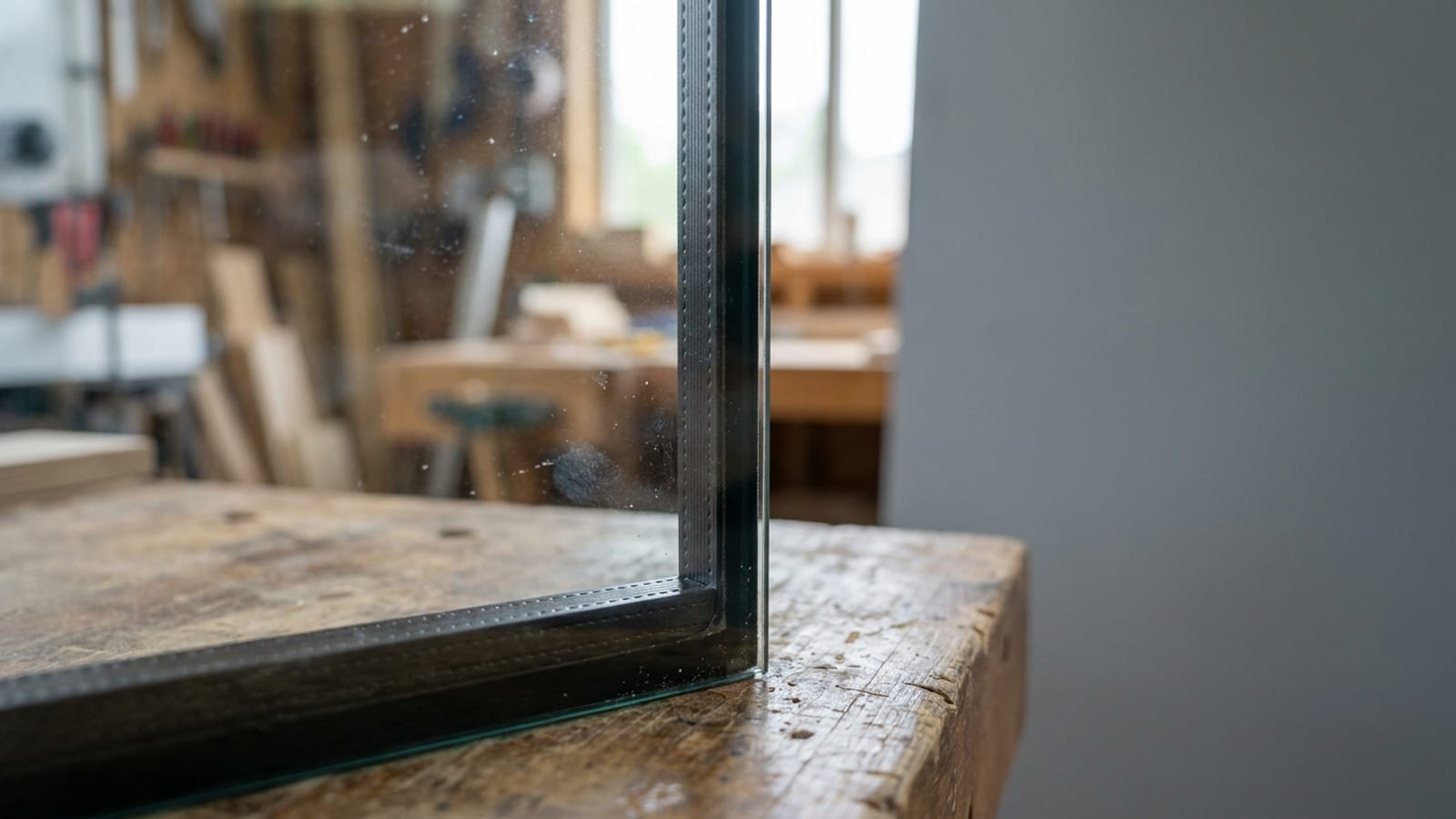
A layer of plastic interlayer bonded between two thin sheets of glass. The interlayer damps vibration instead of transmitting it, which is why laminated glass is the single most effective noise upgrade available on a normal replacement window. It also holds together when broken, which is why it shows up in security and hurricane applications.
Two panes of different thickness
This one is cheap and clever. Two identical panes tend to resonate at the same frequency and pass it through together. Make one pane thicker than the other and they no longer agree on which frequency to transmit, and the assembly blocks more across the range. Asking for dissimilar glass thickness is often the best value on the list.
A wider air space
More distance between the panes decouples them. There are practical limits inside a standard frame, but a wider gap helps, and this is part of why an old-fashioned exterior storm window over a primary window can perform surprisingly well acoustically.
More mass
Thicker glass blocks more sound than thinner glass. It is the least elegant lever and it works.
| Upgrade | Effect on noise | Notes |
|---|---|---|
| Sealing the opening properly | Largest | Free with a correct installation |
| Laminated glass | Large | The most effective glass upgrade |
| Two panes of different thickness | Moderate to large | Inexpensive way to break resonance |
| Wider air space | Moderate | Limited by frame depth |
| Thicker glass | Moderate | Simple mass |
| Third pane, same thickness | Small | Costs the most, does the least for noise |
| Argon fill | Negligible for noise | Real benefit, but it is a thermal one |
That last row surprises people. Argon fill and low-E coatings are worth having and we spec them, but they are working on heat, not sound.
Where does the rest of the noise come from?
Setting expectations honestly matters here, because a window is one component of a wall.
Sound also arrives through the walls themselves, through the entry and patio doors, through attic and crawlspace vents, through recessed light cans, and through the roof. If you are on a busy road, replacing the windows will make a clear difference and will not make the room silent. Homeowners usually describe the result as going from loud to livable.
Frequency matters too. Voices, dogs, mowers and car doors are higher-frequency sounds and are relatively easy to knock down. Truck engines on a grade, interstate hum and aircraft are low-frequency and much harder. That is what the OITC rating exists to describe, and it is the more relevant number than STC if your problem is traffic.
Which rooms are worth treating?
You do not have to solve the whole house to fix the problem.
- Bedrooms first. Noise matters most when you are trying to sleep, and bedrooms are usually a small share of the window count.
- Then the room facing the source. Whichever elevation faces the road, the school, the rail line or the neighbor.
- Then everything else, if it still bothers you.
Phasing by elevation is a normal plan and we quote it that way. Measure the whole house at once so the product line and glass package match when you come back for the rest.
Does the frame material matter?
Less than the glass and much less than the installation. Vinyl and composite frames are both fine acoustically, and vinyl is the right choice for most homes in this market with the savings better spent on the glass package. Where frames matter for noise is at the seal — a casement pulls into a compression seal all the way around, which is marginally tighter than a sliding sash, and on a noise-critical opening that is a small point in casement's favor.
What does the noise upgrade cost?
Replacement windows with us run $700 to $2,200 per window installed, and acoustic upgrades sit inside that range rather than outside it. Laminated glass and dissimilar-thickness glazing are glass-package line items, so they show up per opening on an itemized quote and you can apply them to the three windows that need it rather than to the whole house.
That is the practical way to buy a noise fix: get the glass right where the noise is, and take the standard package everywhere else.
While you are specifying glass, remember what else it has to do here. Our whole service area sits in the ENERGY STAR South-Central climate zone, where a qualifying window needs a U-factor of 0.28 or lower and a solar heat gain coefficient of 0.23 or lower. A noise-focused glass package still has to hit those numbers, and a good estimator will spec both at once rather than trading one for the other.
Larger projects are commonly spread out with GreenSky financing, which includes no-interest options if paid in full within 6, 15 or 18 months and fixed-rate terms starting at 6.99% APR for 60 months, with zero down for most approved homeowners, subject to credit approval.
What we install is covered in writing under The Patriot's Promise, material and labor both, transferable once and prorated after that.
What is the next step?
Tell the estimator which rooms are the problem and what the noise is. "Trucks on the highway at night in the back bedroom" gets you a different glass specification than "the neighbor's dog," and both are better inputs than "I want quiet windows." At a free in-home estimate we measure every opening, spec the glass by elevation and by what the room needs, and give you one itemized price. There is no trip charge inside our service area.
Request a free estimate or call (423) 830-7138.