Short answer
Yes, both are worth it, and on most quality replacement windows you are not paying a large premium because argon fill and a warm-edge spacer are already built into the glass package. Argon slows heat moving through the air space between the panes, and a warm-edge spacer keeps the perimeter of the glass warmer so condensation and heat loss at the edge drop. Neither one transforms a house by itself, but together they are the cheapest real performance you can buy in a window.
Argon gas and warm-edge spacers are worth the money, and the good news is that you usually are not paying a big premium for them. On most quality replacement windows sold in Tennessee, Georgia and Alabama, argon fill and a warm-edge spacer are already part of the standard insulated glass unit rather than a line-item upgrade. The question for a homeowner is less "should I add these" and more "does the window I am being quoted actually have them, and what do they buy me?"
This is the part of a window nobody can see from the sidewalk. It is also the part that quietly decides how the glass feels on a January morning and whether the bottom corners of your windows sweat every winter.
What does argon gas actually do between the panes?
A double-pane window is two sheets of glass separated by a sealed air space. Heat moves across that space by conduction through the gas and by convection, where the gas warms on one side, rises, cools on the other side and falls — a little circulating loop that carries heat from the warm pane to the cold one.
Argon is denser than air and conducts heat more slowly. It is also heavier and more sluggish, so that convection loop weakens. Swap air for argon in a sealed cavity of the right width and the center-of-glass U-factor improves by a modest but genuine margin. It is not a dramatic number on its own. It is, however, one of the least expensive ways to improve a window's insulating value, which is exactly why it became standard equipment on the replacement windows we spec rather than an add-on.
The gap width matters as much as the gas. Too narrow and conduction dominates; too wide and convection takes over. Manufacturers tune the spacer thickness to the fill, which is one reason buying a random "argon upgrade" without knowing the unit construction is meaningless.
Argon also works alongside the low-E coating rather than duplicating it. The coating handles radiant heat — the infrared energy that makes a sunlit room hot. Argon handles conducted and convected heat through the cavity. Different jobs, same assembly.
What about krypton?
Krypton insulates better than argon per inch and costs considerably more. It makes sense in very narrow cavities, which is why it shows up mostly in triple-pane units where each gap has to be thin to keep the overall unit manageable. In the South-Central climate zone, where cooling load dominates, we do not recommend triple pane as a default and the krypton question usually answers itself.
What is a warm-edge spacer, and why does it matter?
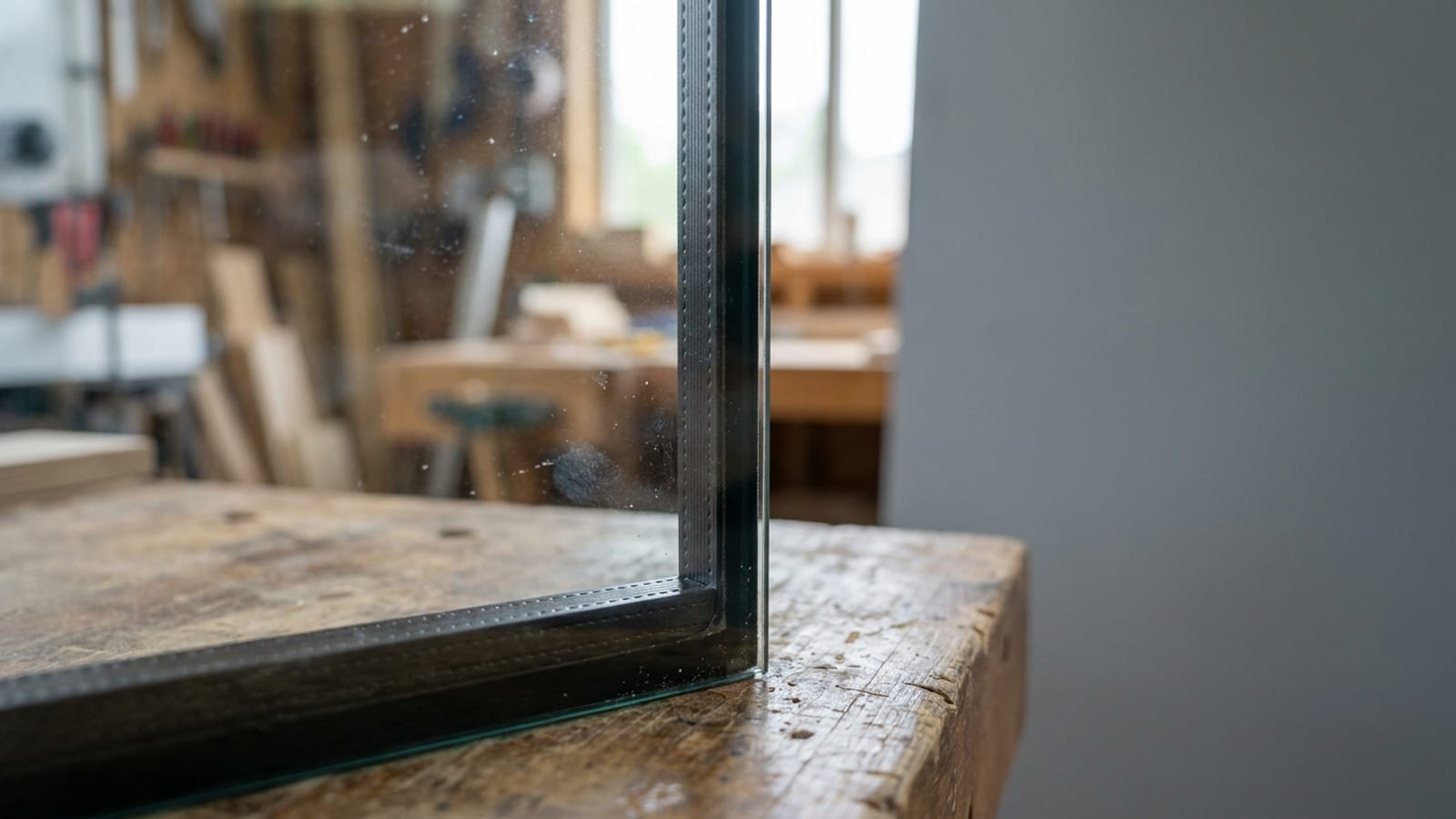
The spacer is the bar running around the perimeter between the two panes. It sets the gap, holds the desiccant that keeps the cavity dry, and carries the sealant that keeps the gas in and moisture out. It is a small part doing three important jobs.
For decades the standard spacer was aluminum. Aluminum is cheap, dimensionally stable and an excellent conductor of heat — which is the problem. An aluminum spacer short-circuits the thermal break you just paid for at the edge of the glass. All the insulating value in the middle of the unit gets bypassed around the perimeter.
A warm-edge spacer replaces aluminum with a lower-conductivity material: stainless steel in a thin profile, structural foam, or a thermoplastic. Three things improve as a result.
- The glass edge runs warmer. That is where interior condensation starts, because the edge is the coldest surface on the window. Raise that temperature and the sweating line moves or disappears.
- The whole-unit U-factor improves. NFRC ratings are whole-window numbers, not center-of-glass numbers, so the edge detail shows up directly in the rating on the label.
- The seal lasts longer. Materials that flex a little with the daily expansion and contraction of glass put less stress on the sealant than a rigid bar does. Seal life is the life of the insulated glass unit, because a failed seal is what puts permanent haze between the panes.
How do these upgrades compare to everything else in the glass package?
Here is the honest ranking of glass-package components for a home in the Tennessee Valley, North Georgia or Northeast Alabama.
| Component | What it does | Relative cost | Worth it in this climate |
|---|---|---|---|
| Low-E coating | Blocks radiant solar heat, drives SHGC | Low, usually standard | Yes — the single biggest lever here |
| Argon fill | Slows conduction and convection in the cavity | Very low, usually standard | Yes |
| Warm-edge spacer | Warms the glass perimeter, improves seal life | Low, usually standard | Yes |
| Laminated pane | Cuts sound transmission, adds security | Moderate | Situational — noise or impact concerns |
| Third pane (triple glazing) | Further U-factor improvement | High | Rarely — slow payback in a cooling climate |
The pattern is clear. The cheap items near the top of the list give you most of the available gain, and the expensive item at the bottom gives you the least here. That is why we would rather put a homeowner's money into a better coating, argon and a good spacer than into a third pane of glass.
For context on what the glass has to achieve: our entire service area sits in the ENERGY STAR South-Central zone, where a qualifying window needs a U-factor of 0.28 or lower and an SHGC of 0.23 or lower. Argon and warm-edge spacers are both U-factor contributors. The coating is what carries the SHGC number, and in this market SHGC is the one that governs summer comfort.
Does the argon leak out over time?
Some of it does, slowly. A sealed glass unit is not a pressure vessel, and gas migrates through the sealant at a very low rate — manufacturers generally design to a loss on the order of a small percentage per year. Over a normal service life, a well-built unit keeps the large majority of its fill, and the performance curve declines gradually rather than falling off a cliff.
What does fall off a cliff is a failed seal. When the perimeter seal gives way, the fill is gone quickly and moist outdoor air enters the cavity. The result is the permanent fog between the panes that no cleaning method reaches, because the affected surfaces are inside a sealed assembly. That is a different problem from condensation on the room-side face of the glass, which is almost always indoor humidity rather than a window defect.
Seal integrity is where the spacer earns its keep a second time. A spacer system that handles thermal movement and bonds well to glass is the difference between a unit that stays clear and one that hazes early.
How do you confirm your quote actually includes them?
This is where it gets practical, because two quotes with the same bottom line can contain very different glass.
- Ask for the exact product line and series, not just "vinyl double-hung."
- Ask for the NFRC numbers — U-factor and SHGC — on the specific units being quoted.
- Ask whether the units are argon filled and what spacer system the manufacturer uses.
- Ask whether the glass package changes by elevation, because the same window should not go on every side of a house.
- Ask for the labor term on the warranty, not just the material term.
We spec glass by elevation for the reason above: the west and south walls take the solar load, and that is where the coating selection matters most. Our windows carry a lifetime material and labor warranty under the Patriot's Promise, transferable once and prorated after that, so the seal and the installation are both covered in writing rather than verbally.
What do argon and warm-edge spacers add to the price?
Usually nothing visible, because they are built into the units we quote rather than tacked on. Replacement windows in our market run about $700 to $2,200 per window installed, and that figure covers the unit, the labor, the sealing and the trim work. Where a project lands inside that range is driven by opening count and size, frame material, whether the job is insert or full-frame, and what the crew finds when the old unit comes out — not by whether the cavity holds argon.
If a quote is noticeably cheaper than the others, the glass package is one of the first places to look for the difference. A clear coating with no argon and an aluminum spacer is a meaningfully different product than a low-E, argon-filled unit with a warm-edge spacer, and it will not read any differently on a one-line proposal.
For homeowners spreading the cost, financing through the GreenSky program includes no-interest-if-paid-in-full plans at 6, 15 or 18 months and fixed-rate terms, with zero down for most approved homeowners, subject to credit approval.
Where do these upgrades matter least?
Being straight about the limits: argon and a warm-edge spacer cannot fix a bad installation. Air leaking around a window — through an unsealed shim space, a gap behind the trim, or a frame that was never properly insulated at the perimeter — moves far more heat than the difference between air fill and argon fill ever will. The glass package is the second conversation. The opening comes first.
They also do very little for noise, and they do not change how much sun pours through a west-facing window. Those are the coating's job and, for sound, the pane construction's job.
Your next step
If you want to know what is actually in the glass on your house and what a correctly specified package would look like on each elevation, schedule a free in-home estimate. An estimator measures every opening, checks the condition of the frames and sills, shows you the product and the glass options, and gives you one itemized price per opening with the install method spelled out. It is a sales appointment, and it is also the only way to get a real number instead of a guess.