Short answer
An estimator comes to the house, measures every opening you want quoted, checks the condition of the frames and sills, asks how each room performs in summer and winter, shows you the actual product and glass options, and gives you one itemized price per opening with the install method spelled out. Plan on 45 to 90 minutes for a whole house. It is a sales appointment, and it is also the only way anyone can give you a real number instead of a guess.
An estimator comes to the house, measures every opening you want quoted, looks at the condition of each frame and sill, asks how the rooms actually perform, shows you the product and the glass, and leaves you with one itemized price. Plan on 45 to 90 minutes for a whole house.
It is a sales appointment. We say that plainly because pretending otherwise does nobody any favors. What it is not is a two-hour sit-down presentation, a ten-step pitch, or a price that expires when the estimator leaves your driveway. You get a number, and the number is the same tomorrow.
Why can nobody quote windows over the phone?
Because the two things that decide your price cannot be seen from a phone call: how many openings you have and what condition they are in.
A standard double-hung in a sound, square frame and a seven-foot picture unit over a stairwell are both "one window" on a count sheet and nowhere near the same price. An opening whose sill has gone soft needs full-frame replacement, which typically adds several hundred dollars over an insert. A phone estimate has to assume the easy case for every opening, which is why phone numbers and final numbers so often disagree.
If you want a planning figure before anyone visits, count your openings and multiply by a mid-range number. Replacement windows with us run $700 to $2,200 per window installed. That arithmetic will not be your quote, but it tells you which conversation you are in.
What actually happens, step by step
Measuring every opening
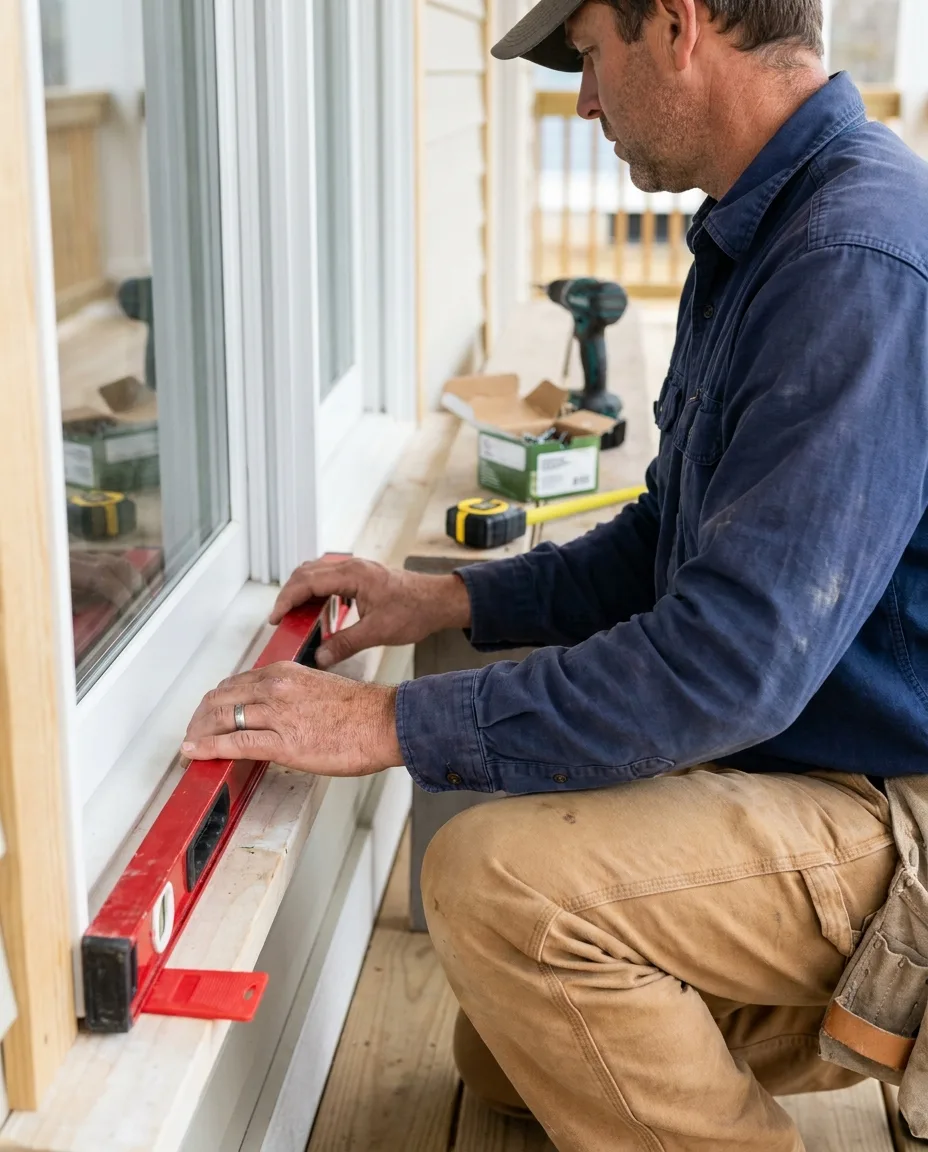
The estimator measures width, height and depth at each opening, usually in more than one place, because old openings are rarely still square. These are the measurements the windows get built to — replacement windows are manufactured to your house rather than pulled off a shelf, which is why the lead time from signing to install is mostly manufacturing.
Checking the frames and the sills
This is the part that decides the method, and it is why the estimator will be pressing on things. Sound, square frames can take an insert replacement, which drops a new window into the existing frame. A rotted sill, a frame that is out of square, a history of water intrusion, or old aluminum frames eating your glass area all point to full-frame, which removes everything down to the rough opening.
Many houses correctly get a mix, and a good quote says which method applies to which opening rather than assuming one for the whole house.
Asking how the house performs
Expect questions like these, and expect them to change the specification:
- Which rooms are uncomfortable, and at what time of day?
- Which windows do not open, do not stay up, or do not lock?
- Any fog between the panes? Any staining on the trim or drywall below a window?
- How long do you plan to be in the house?
- Is there a room you are planning to change — a kitchen, an addition, a porch enclosure?
The time-of-day question is not small talk. A living room that is unusable at four in the afternoon is a solar heat gain problem, and the fix is the coating on the glass rather than a bigger window.
Showing you the product
You see the actual window — the frame, the sash, the hardware, the glass — instead of a photograph. That includes the difference between vinyl and composite frames, and what the glass package is doing.
Our whole service area sits in the ENERGY STAR South-Central climate zone, where a qualifying window needs a U-factor of 0.28 or lower and a solar heat gain coefficient of 0.23 or lower. SHGC is the number that matters most here because our load is cooling, not heating. That is why we spec glass by elevation instead of putting the same unit on all four sides of a house, and it is worth asking to see that on your quote.
Giving you the price
One itemized number, with the openings listed, the install method noted, and the glass package specified. Not a number that starts high and drops three times before you sign.
What should you have ready?
You do not need to prepare much, but four things make the appointment faster and the quote better.
| Have this ready | Why it helps |
|---|---|
| Access to every window, inside and out | Anything blocked cannot be measured, and unmeasured openings get left off |
| A list of the specific complaints, room by room | "The back bedroom is hot by 3pm" changes the glass spec for that wall |
| Everyone who is part of the decision | So the conversation happens once |
| Any HOA or historic-district rules you know about | Some neighborhoods restrict frame color, grid pattern or material |
Moving furniture away from the windows and clearing a path outside the house helps more than anything else on that list.
What should you ask the estimator?
Ask these, of us and of anyone else you have out:
- Is this opening quoted as insert or full-frame, and why?
- What exact product line and series is this, and what is the U-factor and SHGC on the glass?
- Does the price include disposal, trim and interior finish work, or are those extra?
- What is the labor term on the warranty, not just the material term?
- What happens to the price if the crew finds rot when the old unit comes out?
That fourth one catches more bad quotes than any other. A lifetime material warranty paired with a one-year labor warranty is a much weaker promise than it sounds. What we install is covered under The Patriot's Promise, material and labor both, transferable once and prorated after that.
What happens after the estimate?
You have a quote and no deadline attached to it. If you move forward, the order goes in against your measurements, we commit to your dates in a signed timeline agreement, and manufacturing is most of the wait. Installation itself is typically one to two days for a whole house, with each opening taking 30 to 60 minutes as an insert or two to four hours full-frame.
If the number is more than you want to spend at once, there are two normal paths. Phase the work by elevation, worst side first. Or use GreenSky financing, which includes no-interest options if paid in full within 6, 15 or 18 months and fixed-rate terms starting at 6.99% APR for 60 months, with zero down for most approved homeowners, subject to credit approval.
One thing not to plan around: there is no federal tax credit for windows placed in service in 2026. The Energy Efficient Home Improvement Credit was terminated for property placed in service after December 31, 2025.
What is the next step?
Book a time and have the house looked at. Our hours are Monday through Thursday 8:00 AM to 6:00 PM and Friday and Saturday 9:00 AM to 3:00 PM. There is no trip charge anywhere in our service area across Tennessee, Georgia and Alabama.
Request a free in-home estimate or call (423) 830-7138.