Short answer
Most homeowners pay for siding one of four ways — cash, contractor-arranged financing through the GreenSky program, a home equity line, or an insurance claim when the damage is storm-related. Siding is harder to phase than windows because the whole envelope comes off and goes back on as one system, so the decision is usually about how to spread one number rather than how to split the work. The promotional no-interest plans reward a payoff date you can actually hit; the fixed-rate terms are for spreading it out on purpose.
Most homeowners pay for siding one of four ways: cash, contractor-arranged financing through the GreenSky program, a home equity line, or an insurance claim when a storm caused the damage. Which one fits depends less on the amount than on whether you have a payoff date you can actually name.
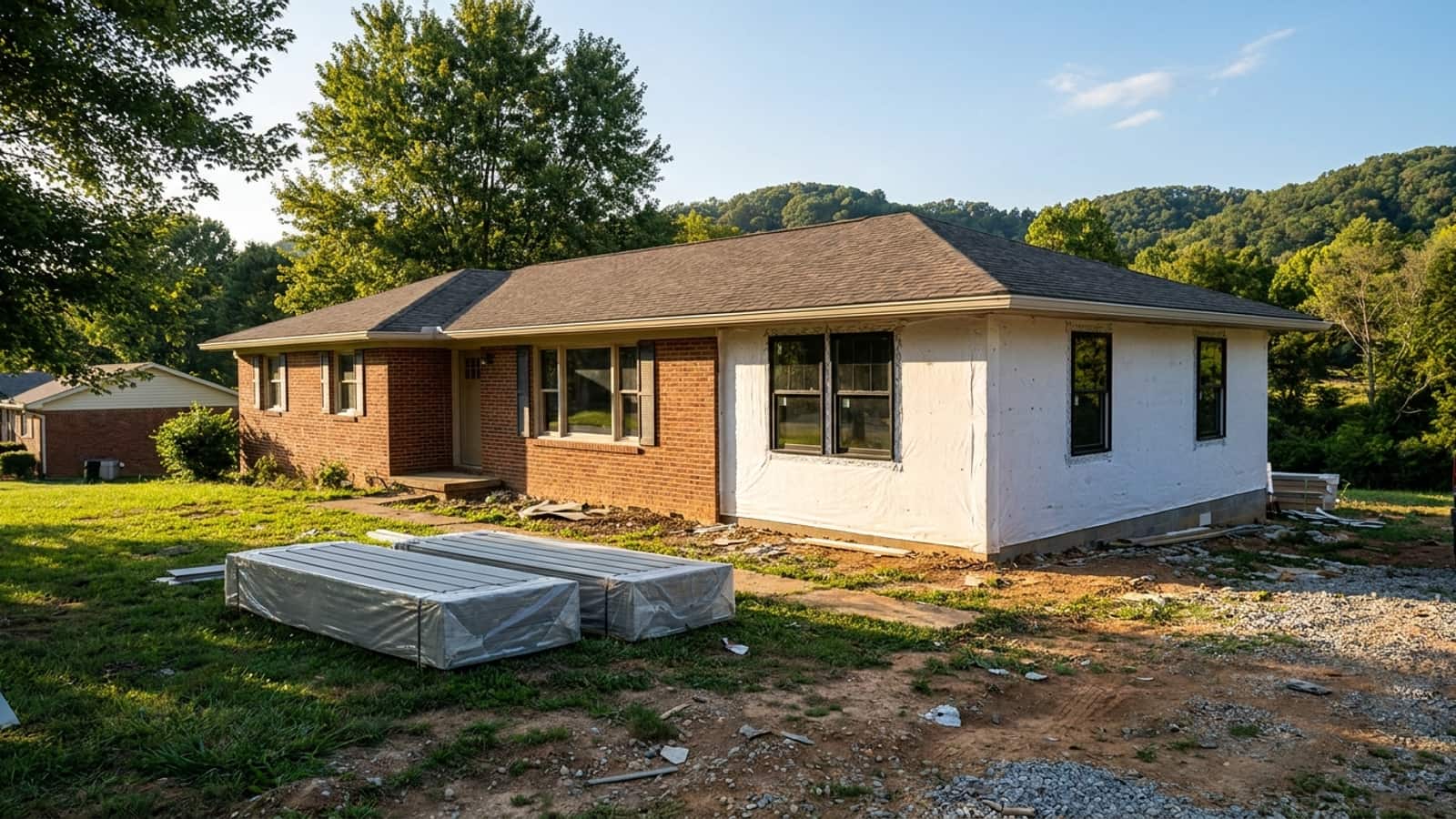
Siding differs from a window project in one way that matters to the financing decision. Windows can be phased — do the west elevation now, the rest next year. Siding mostly cannot, because the house wrap, flashing and trim tie together at the corners and terminations, and stopping partway means building a temporary edge that has to be undone later. So the question is usually how to spread one number rather than how to split the work.
What is the number you are spreading?
Full siding replacement with us runs $12,000 to $25,000 for a typical home, including trim, soffit, fascia and house wrap. Where a specific house lands depends on square footage, the number of stories and corners, the material, and what the crew finds once the old cladding comes off.
That last item is the honest caveat on any siding budget. Nobody can see the sheathing from the curb, and soft sheathing has to be made sound before new siding goes on. Ask any company how repair scope gets priced before work starts, and build a little room into your plan for it.
Material choice moves the number too. Quality vinyl is the value answer and typically lasts 20 to 40 years. James Hardie fiber cement costs more, lasts roughly 30 to 50 years, and holds its color against Southeast sun and humidity. Under five years in the house, vinyl usually makes sense. Ten years or a forever home, fiber cement usually wins on total cost of ownership. Fiber cement on the street-facing elevations with vinyl elsewhere is a common compromise and a real way to manage the budget without compromising the assembly.
How do the four options compare?
| Option | Best for | Watch out for |
|---|---|---|
| Cash | Anyone who has it set aside | Draining a reserve right before a roof or an HVAC decision |
| Promotional no-interest plan | A payoff date you can name and hit | Interest terms applying to any balance left at the end of the window |
| Fixed-rate term | Spreading the cost on purpose over years | Paying more in total interest the longer the term |
| Home equity line | Homeowners with equity and time to set it up | Slower, and the house secures the debt |
| Insurance claim | Sudden storm damage | Does not cover wear, fading or age |
What are the financing options through us?
We finance through the GreenSky program, and the plans fall into two groups.
No interest if paid in full within the promotional period. There are three windows — 6, 15 and 18 months. The 6-month and 18-month plans require no payments during the promotional period; the 15-month plan has low payments during it. Every one of them charges no interest provided the balance is paid in full before the window closes.
Fixed-rate terms. These are for spreading the cost deliberately. A fixed 6.99% APR over 60 months works out to $19.80 per month for every $1,000 financed. A fixed 9.99% APR over 144 months works out to $11.94 per month per $1,000. There is also a 120-month option at rates from 9.99% to 22.99% APR.
Zero down is available for most approved homeowners. All of it is subject to credit approval, and lending is through GreenSky program banks.
The per-$1,000 figures are the useful part when you are planning, because they let you do the arithmetic on your own number before anyone quotes you. Take the figure you expect, divide by 1,000, multiply by the monthly factor.
When does insurance pay instead?
When the damage was sudden and caused by a covered peril — hail, wind, a limb through a wall. Insurance is not a maintenance fund, and no policy pays to replace cladding that has faded, chalked, gone brittle or simply reached the end of its life.
If a storm did come through, three things help:
- Document it promptly. Dated photos from several angles, including close-ups of impact marks.
- File within your policy's window. Most policies limit how long after the event you can claim.
- Have the damage inspected by someone who will put it in writing. An adjuster is assessing a specific event, and a clear written description of what failed and why helps.
A claim and a financing plan are not mutually exclusive. It is common for a claim to cover part of the scope while the homeowner upgrades material or extends the work to elevations the storm did not touch, and finances that difference.
Does new siding pay you back?
Partly, and in more than one currency. Re-siding is consistently among the higher-return exterior projects in resale studies, and it changes curb appeal more dramatically than almost anything else you can do to a house.
Be careful with energy claims, including ours. Siding is a rain screen, not insulation. What improves comfort during a replacement is the envelope work that happens along the way — the old cladding comes off, gaps and failed housewrap get corrected, and the assembly gets properly sealed. That is a real improvement and a modest one. Anyone promising a dramatic utility saving from siding alone is overselling it.
One thing not to plan around: there is no federal tax credit for siding placed in service in 2026. The Energy Efficient Home Improvement Credit was terminated for property placed in service after December 31, 2025. Work performed in 2025 or earlier may still be claimable on that year's return, and a tax advisor can confirm.
What should you ask before you sign anything?
Ask these of us and of anyone else you are considering:
- What exactly is in the scope — does it include trim, soffit, fascia and house wrap, or are those separate lines?
- How is repair scope priced if the sheathing is soft when the old siding comes off?
- What is the labor term on the warranty, not just the material term? Siding with us carries 30-year material and labor coverage under The Patriot's Promise, with $2M insurance on every job.
- Who is physically doing the work?
- On the financing, what happens to any balance left at the end of a promotional period?
That last question is the one people skip and later wish they had not.
What is the next step?
Get the number before you plan around it. At a free in-home estimate the estimator walks every elevation, checks the trim, soffit and fascia, and gives you one itemized price with the material and full scope spelled out — and we will go through the financing options with the actual figure in front of you rather than a hypothetical. There is no trip charge inside our service area.
Request a free estimate or call (423) 830-7138.