Short answer
Insulated vinyl siding is worth it when you want a flatter, more solid-feeling wall and a small continuous R-value gain, and it is not worth it if you are buying it mainly to cut the power bill. The foam backing typically adds somewhere around R-2 to R-3 depending on the profile, which is real but modest next to attic insulation or air sealing. Where it consistently earns its cost is rigidity, impact resistance and how straight the wall reads in afternoon light.
Insulated vinyl siding is worth the upgrade for some houses and a waste of money on others, and the deciding factor is usually what you want out of it. If you want a wall that looks flatter and straighter, panels that feel solid instead of hollow when something bumps them, and a small continuous layer of insulation across the studs, it is a good buy. If you are buying it because someone told you it would transform your power bill, you will be disappointed.
Here is what the foam actually does, what it does not do, and how to decide whether it belongs on your siding replacement.
What is insulated vinyl siding, exactly?
Standard vinyl siding is a formed panel with air behind it. The profile gives it its shape, and the back of each panel is open, which is why a hollow panel flexes under hand pressure and reads a little wavy on a long wall.
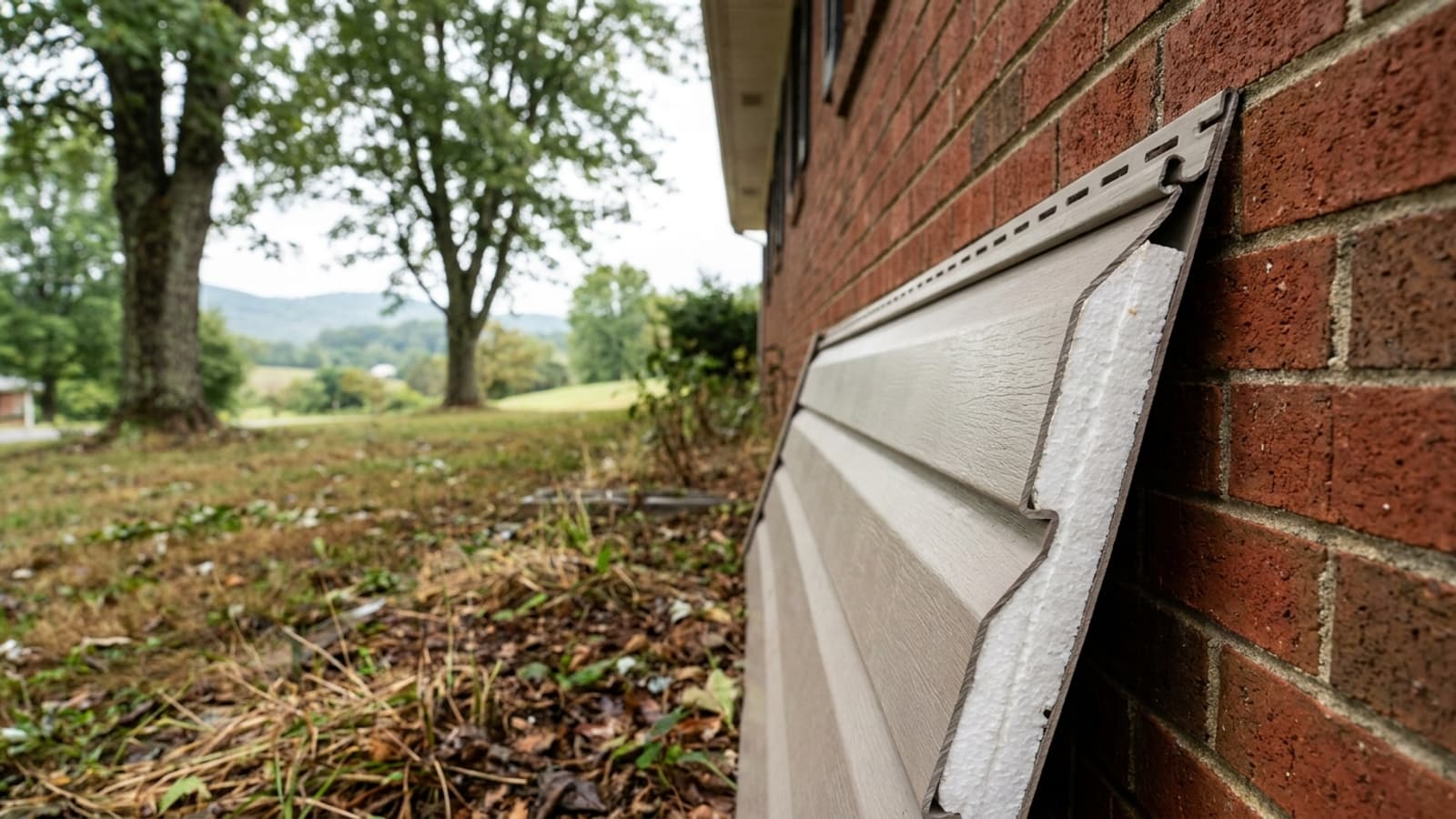
Insulated vinyl siding is the same panel with a contoured block of rigid expanded polystyrene foam bonded to the back. The foam is cut to match the panel profile exactly, so it fills the void behind the face and sits tight against the wall. That one change affects three things at once: the thermal performance of the assembly, the stiffness of the panel, and how flat the finished wall looks.
It is still vinyl. It still locks together the same way, still gets nailed through a slotted hem so it can expand and contract with temperature, and still comes in the same color ranges and profiles. The upgrade is the backer, not a different material.
How is this different from adding foam board separately?
Some contractors install a layer of flat foam sheathing over the wall and then hang hollow vinyl over it. That also adds R-value and also flattens the wall, and it is a legitimate approach. The difference is that laminated insulated panels keep the foam locked to the panel profile, so the foam cannot shift, and the panel gets the structural benefit of the backer. Flat foam under hollow siding leaves an air gap behind every panel contour and does nothing for panel rigidity.
How much insulation does it actually add?
This is where honest numbers matter. Hollow vinyl siding contributes almost nothing thermally on its own — the R-value credit is well under R-1. Insulated vinyl, depending on profile and foam thickness, typically lands somewhere in the neighborhood of R-2 to R-3. Check the specific product's published figure rather than assuming, because thicker profiles carry more foam.
That is a real improvement, and it has one quality worth paying attention to: it is continuous. Your wall cavity insulation stops at every stud, and the studs themselves conduct heat straight through the wall — thermal bridging. A continuous layer outside the framing covers the studs too, which is why a couple of R-points on the outside of the wall do more than the same number added inside a cavity.
It is still a couple of points. In the Tennessee Valley, North Georgia and Northeast Alabama, cooling load dominates, and the biggest levers on a hot August afternoon are attic insulation, duct sealing, air sealing and the solar heat gain coming through your glass. Siding foam helps at the margins. Treat any sales claim about dramatic bill reductions from siding alone with skepticism.
How do the common cladding choices compare?
| Option | Added R-value | Wall flatness | Impact resistance | Typical lifespan | Relative installed cost |
|---|---|---|---|---|---|
| Hollow vinyl | Negligible | Shows wall irregularities | Lowest of the three | 20-40 years | Lowest |
| Insulated vinyl | Roughly R-2 to R-3 | Noticeably flatter | Better — foam backs the face | 20-40 years | Moderate |
| Fiber cement | Negligible on its own | Very flat, rigid board | Highest — resists hail and impact | 30-50 years | Highest |
Notice that fiber cement does not bring insulation to the table either. If thermal performance is the goal, the comparison is insulated vinyl against hollow vinyl, not vinyl against James Hardie. If appearance longevity and impact resistance are the goal, fiber cement is the stronger answer and we will price both at the estimate.
Does insulated vinyl siding cost more?
Yes, on the material line. Labor does not change much — the crew is tearing off the old cladding, inspecting sheathing, installing house wrap and hanging panels either way. What changes is the price per square of the product itself, and on a whole house that adds up.
Full siding replacement in our market typically runs $12,000 to $25,000 installed, including trim, soffit, fascia and house wrap. Where your house lands inside that range depends on square footage, number of stories, how much trim detail your elevations carry, and what the sheathing looks like once the old siding is off. An insulated panel moves you up inside that range rather than outside it on most homes.
If spreading the number is the question rather than the number itself, financing through the GreenSky program includes no-interest-if-paid-in-full plans at 6, 15 or 18 months and fixed-rate terms for longer payoffs, with zero down for most approved homeowners.
When is insulated vinyl the right call?
These are the situations where we think the upgrade is money well spent.
- The existing walls are not flat. Older homes with board sheathing, settled framing or a history of patched siding show every ripple through hollow vinyl. Foam-backed panels bridge minor irregularities and produce a straighter shadow line.
- The house has no wall cavity insulation, or very little. On a house with empty or thin wall cavities, a continuous exterior layer is a meaningful share of the wall's total performance instead of a rounding error.
- The elevation takes abuse. Yard equipment, hail, ladders, kids and basketballs all meet a backed panel better than a hollow one.
- You dislike the sound of hollow siding. Wind-driven rain on hollow vinyl has a drum note to it. The foam kills most of that.
- You are staying a while but fiber cement is out of budget. Insulated vinyl is the sensible middle of the range.
When is it not worth it?
Skip the upgrade if you are selling within a few years and the goal is curb appeal at the lowest cost — buyers do not inspect for foam backing. Skip it if your walls are already flat, well insulated and well sealed, because the incremental gain is small. And skip it if the budget conversation is really a fiber cement conversation in disguise; on a forever home with architectural detail worth doing well, the money often goes further in a different material rather than a better version of the same one.
What does a correct installation look like?
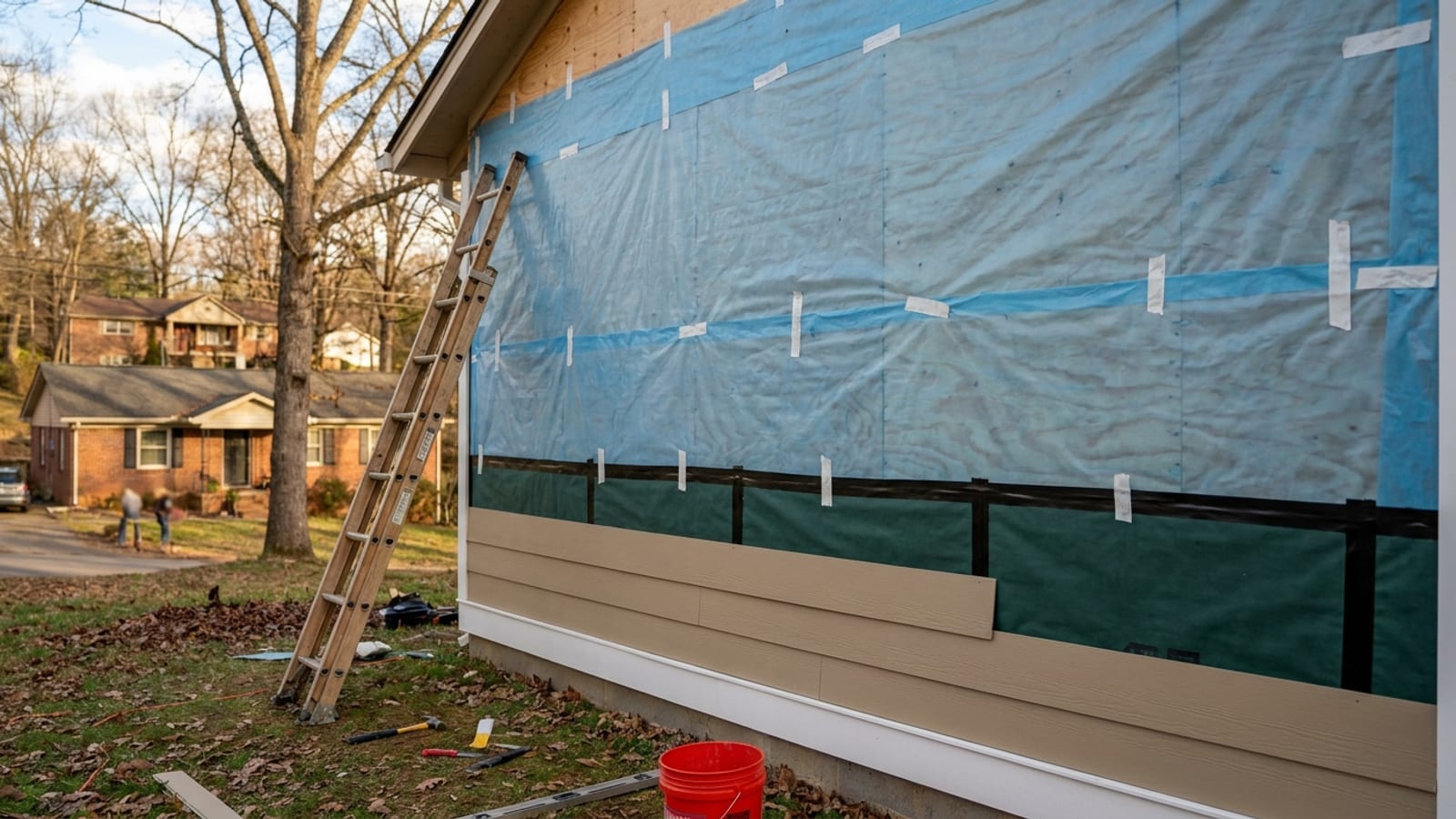
The panel matters less than the system around it. On every full siding replacement we strip the old cladding to the sheathing, inspect and repair what we find, install a water-resistive barrier, flash the window and door openings, and then hang the siding to manufacturer specification with proper fastening and expansion clearance. Vinyl of any kind moves with temperature, and panels nailed too tight buckle in July no matter how good the product is.
The other detail homeowners underestimate is thickness. Insulated panels are thicker than hollow ones, which changes how trim, J-channel, corner posts and window returns stack up. Those details have to be planned, not improvised at the wall, or the finished edges look thin and the windows look recessed in an odd way. Trim, soffit and fascia come as part of the envelope here rather than as an afterthought.
Siding work is covered by the Patriot's Promise at 30 years on material and labor, backed in writing with $2 million in liability insurance on the job and owners who handle both the front end and the back end of every project.
What is the next step?
Walk the house and decide what you actually want from the wall: a flatter appearance, a tougher surface, a small continuous insulation gain, or the lowest number on the page. Those point to different products, and it is a far more useful conversation than a yes-or-no on foam.
Then schedule a free in-home estimate. An estimator measures the elevations, looks at the condition of the existing cladding and trim, shows you hollow vinyl, insulated vinyl and fiber cement side by side, and gives you one itemized price for each. It is a sales appointment, and it is also the only way to get a real number instead of a guess, because no two walls are found in the same condition once the old siding comes off.