Short answer
Quality modern vinyl windows are built to resist both, and a well made white vinyl frame will hold its color for decades in Tennessee, Georgia and Alabama sun. Yellowing is mostly a problem of older or low grade PVC with weak UV packages, while slow fading and chalking show up first on south and west walls. Dark exterior frame colors are the real variable, which is why the frame material should be chosen for the elevation it faces.
Good vinyl windows made today do not yellow, and they fade far less than the vinyl windows homeowners remember from the 1980s. What they can do, under enough direct sun, is chalk slightly on the surface and shift in tone over many years. That risk is small on a white frame and real enough to plan around on a dark one.
That is the whole answer in short form. The longer answer is about what the frame is made of, which wall it sits on, and how many hours of August afternoon sun that wall takes.
Why did older vinyl windows turn yellow?
Polyvinyl chloride on its own does not handle ultraviolet light well. Raw PVC exposed to sun will discolor and get brittle. The industry solved that a long time ago by compounding the vinyl with titanium dioxide and ultraviolet stabilizers, which absorb and scatter the radiation before it breaks down the polymer chain. The frames that went yellow were generally early units, or budget extrusions where the formulation was thin on those additives.
Two other things made it worse. Older vinyl was often thinner and unreinforced, so heat distortion compounded the visual problem. And a lot of first generation vinyl had surface color applied rather than pigment carried all the way through the extrusion, which means any surface wear showed instantly.
A modern replacement window is a different product. The series we install carry pigment through the extrusion and use reinforced frames, so there is no painted skin to wear off and nothing to warp out of square in July. That is a category improvement across the better manufacturers, not a trick one brand discovered.
What actually causes vinyl to fade in the Southeast?
Three forces work on an exterior frame here, and they do not do the same thing.
Ultraviolet light breaks down the polymer at the surface. This is the one that causes true color loss over a long period.
Heat is the one most people underestimate. Our entire service area sits in the ENERGY STAR South Central climate zone, where cooling load dominates. A dark surface on a west wall in August gets dramatically hotter than a white one next to it, and heat accelerates everything ultraviolet light is already doing.
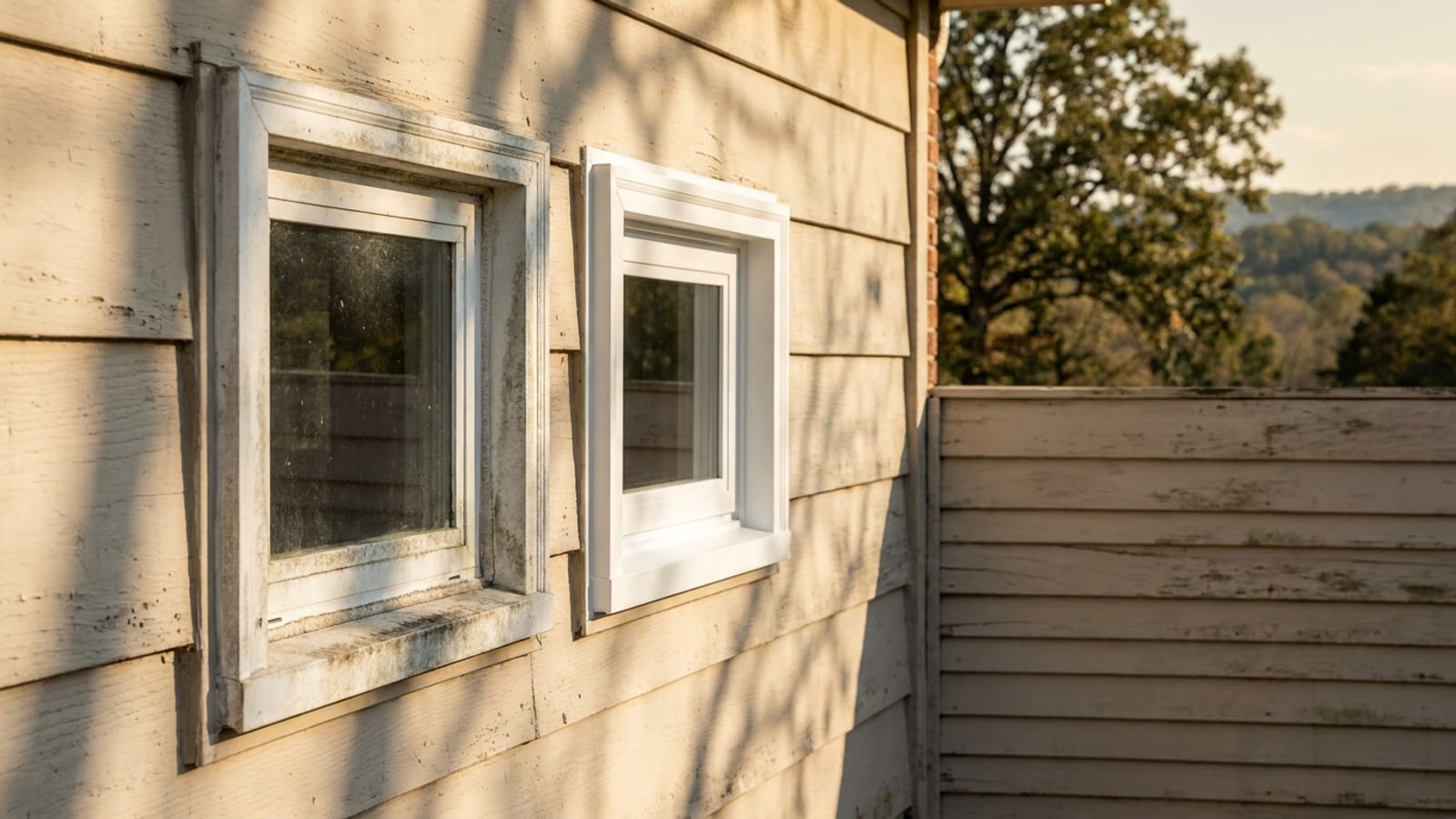
Surface deposits are not fading at all, but they look like it. Pollen in spring, road film, mildew on shaded north and east walls, and hard water spray from a sprinkler all leave a haze that reads as dull color. This is the most common cause of a homeowner thinking their windows have faded, and a bucket of mild cleaner solves it.
Chalking versus fading
Chalking is a powdery residue you can rub off on your finger. It is the surface layer of the material breaking down and releasing pigment. Fading is a change in the material itself. Chalking washes off and often washes off repeatedly for years before anything permanent happens. Fading does not wash off at all. Knowing which one you are looking at tells you whether you have a maintenance task or a replacement conversation.
Which windows on a house fade first?
Always the same ones, and it is predictable enough to plan around at the quoting stage.
| Elevation | Sun exposure | Fade and chalk risk | What to watch for |
|---|---|---|---|
| West | Hard afternoon sun, highest surface temperature | Highest | Chalking on dark frames, heat buildup |
| South | Long daily exposure, high total hours | High | Gradual tone shift over many years |
| East | Morning sun, cooler surface | Low | Mildew film in shaded spots |
| North | Little or no direct sun | Lowest | Mildew and green film, not fading |
The practical takeaway is that fade is an elevation question, not a house question. We spec glass by elevation for the same reason, because solar heat gain coefficient does more for comfort on a west wall in this region than another small improvement in U factor. A qualifying window in the South Central zone needs a U factor of 0.28 or lower and an SHGC of 0.23 or lower, and the frames on that west wall are living in the same conditions the glass is.
Does frame color change the answer?
Yes, more than anything else on the list. White and almond frames carry so little pigment that there is very little to lose, which is why white vinyl has the longest track record of holding its appearance. Dark exterior colors absorb more heat and carry more pigment to break down, so they are the frames where material choice starts to matter.
That is the honest reason fiberglass and composite frames come up when a homeowner wants black or bronze exteriors on a south or west wall. Fiberglass expands and contracts less with temperature swing and takes dark exterior finishes well. It costs roughly 40 to 60 percent more per window, so it is not the default recommendation. It is the right answer in three specific cases: very wide or tall openings, dark exterior frame colors, and where you want the narrowest frame possible for maximum glass.
On a north or east elevation, or when the dark finish is interior only, black and bronze are straightforward choices with very little downside.
How do you keep vinyl frames looking new?
Vinyl is close to maintenance free, not entirely free of it. The routine is short.
- Wash the exterior frames once a year with mild soap and water and a soft brush. Spring, after pollen season ends here, is the natural time.
- Rinse top down. Do not blast a window frame with a pressure washer at close range or at an upward angle, which drives water behind the trim.
- Treat mildew on shaded walls with a mild cleaner rather than scrubbing harder. Mildew is biological growth on the surface, not a stain in the material.
- Avoid abrasive pads, solvents and anything with acetone. They scour the surface and create the dull patch they were supposed to remove.
- Keep sprinkler heads aimed away from the glass and frames. Repeated hard water spray leaves mineral deposits that are genuinely hard to remove.
One more thing worth knowing: do not set a dark grill, a reflective sunshade or a mirrored sign directly against a vinyl frame. Concentrated reflected heat can distort vinyl, and that is heat damage rather than fading.
Can you paint vinyl window frames?
You can, with coatings formulated for vinyl, and it is sometimes the right call on an older frame that is sound but tired. The caution is heat again. Painting a white frame a dark color raises its surface temperature beyond what the extrusion was engineered for, which is how a sound old window ends up bowed. If the frames are thirty years old and chalking badly, paint is usually money spent on a unit that is near the end of its service life anyway.
What should you ask before you buy?
Color retention is a warranty question as much as a product question. When you compare two quotes, ask what the warranty says about finish and color, and ask for the labor term separately from the material term. A lifetime material warranty paired with a one year labor warranty is a much weaker promise than it sounds. Our coverage, The Patriot's Promise, is lifetime on both material and labor for windows, transferable one time and prorated after that.
Also ask what the frames are made of and whether the color goes through the extrusion. Reinforced frames that will not warp, fade or crack are what you are paying for, and that specification should be written on the quote rather than described out loud. Replacement windows run about $700 to $2,200 per window installed in our market, and the spread between the bottom and the top of that range is largely frame material, glass package and opening size. If you are spreading the cost, we offer financing through the GreenSky program, including no interest if paid in full plans and fixed rate terms.
Next step
If your current frames are chalking, yellowed or simply tired, the fastest way to know whether you are looking at a wash, a repair or a replacement is to have someone look at the actual walls. Schedule a free in-home estimate. An estimator measures every opening you want quoted, checks the frames and sills, and gives you one itemized price per opening with the install method spelled out. It is a sales appointment, and it is also the only way anyone can hand you a real number instead of a guess.